

I am not a good flyer. My son likes to say I don’t have a fear of flying — I have a fear of coach. He’s not entirely wrong. First Class doesn’t cure the terror, but it makes it survivable. A few extra inches of breathing room, a proper glass, the comfortable illusion that if this plane goes down, at least I went down in a decent seat.
I drink when I fly. It doesn’t really take the fear away so much as soften the edges. I cry less during takeoff, which I consider progress. Somewhere around the second Bloody Mary, I start to wonder why I’m even afraid. By the third, I’ve removed my claws from my husband’s arm and put the Holy Water back in my bag.
So there I was, settling in, trying to talk myself down from the low-grade panic that flying on an airplane always produces in me, when I noticed the man sitting directly across the aisle. He looked to be in his seventies, nicely dressed, white mustache, The Wall Street Journal open in his lap, looking like the kind of man who reads it on a plane because he actually wants to, not because he’s performing something.
Then something spilled. I’m not sure if it was his fault or the flight attendant’s, but it landed on him, and he snapped. He stood up yelling, refused his breakfast, and when told to be seated, began flicking his Wall Street Journal with the barely contained fury of a man who has been inconvenienced one too many times by a world that really should know better by now. When the man sitting next to him, a quiet, kind-looking man with a long beard and a yarmulke on his head tried to engage him gently, the angry man told him flatly to leave him alone.
The quiet man, a rabbi, did not leave him alone.
“Why don’t you eat,” he said. “I don’t want to!” came the reply, loud enough that several rows turned to look. And then the rabbi did something unexpected. He reached over, placed his napkin carefully across the angry man’s tray, and took hold of his arm. Not aggressively, but in the way you take someone’s arm when you want them to know, without any fuss, that you see them.
He said something I couldn’t hear. Whatever it was, I watched the angry man’s face change in real time, something cracking open around the eyes, the jaw, the rigid set of his shoulders. He looked like a person who had been holding something very heavy for a very long time and had just been given permission to put it down.
By cruising altitude, they were laughing together. The angry man had ordered a vodka. The rabbi, a bourbon. Whatever had been sitting on that man’s chest when he boarded seemed to have shifted, not disappeared, but moved just enough to let him breathe.
I couldn’t stop thinking about it.
My mother had this thing she did when someone behaved badly in public, when someone cut her off on the freeway, snapped at a cashier, or stood in line radiating misery like the sky before a storm that ruins everyone's plans. Not as an excuse, just as a question worth asking before you decide what someone is made of based on their worst ten minutes. She wondered what they might be going through.
I know what it's like to be on the other side of that judgment. Years ago, I drove home from the hospital after sitting at my mother’s deathbed and ran a stop sign in a complete daze. A man in another car screamed at me, flipped me off, and made sure I knew exactly what he thought of me. I sat at that intersection thinking: if you only knew. I wasn’t reckless. I was wrecked. There’s a difference, and it almost never shows on the outside.
As for the man on the plane, I’ll never know what he was carrying. A diagnosis. A phone call he’d gotten in the gate area. Grief that had just chosen that day to make itself known. Or maybe he was simply a difficult man having a terrible day. Maybe both were true at once. People contain multitudes, including the exhausting kind.
What stuck with me is that the rabbi didn’t take the bait. He didn’t match the anger or back away from it. He just stayed, and waited, and offered a napkin and a little dignity, and made room for something else to happen.
I think about the moments in my own life when someone did that for me. When my husband was in the ICU in critical condition, I was the only journalism adviser, the only professor my students had. I wasn’t sleeping. I was going straight from the hospital to the newsroom and back again, running on nothing. My students knew.
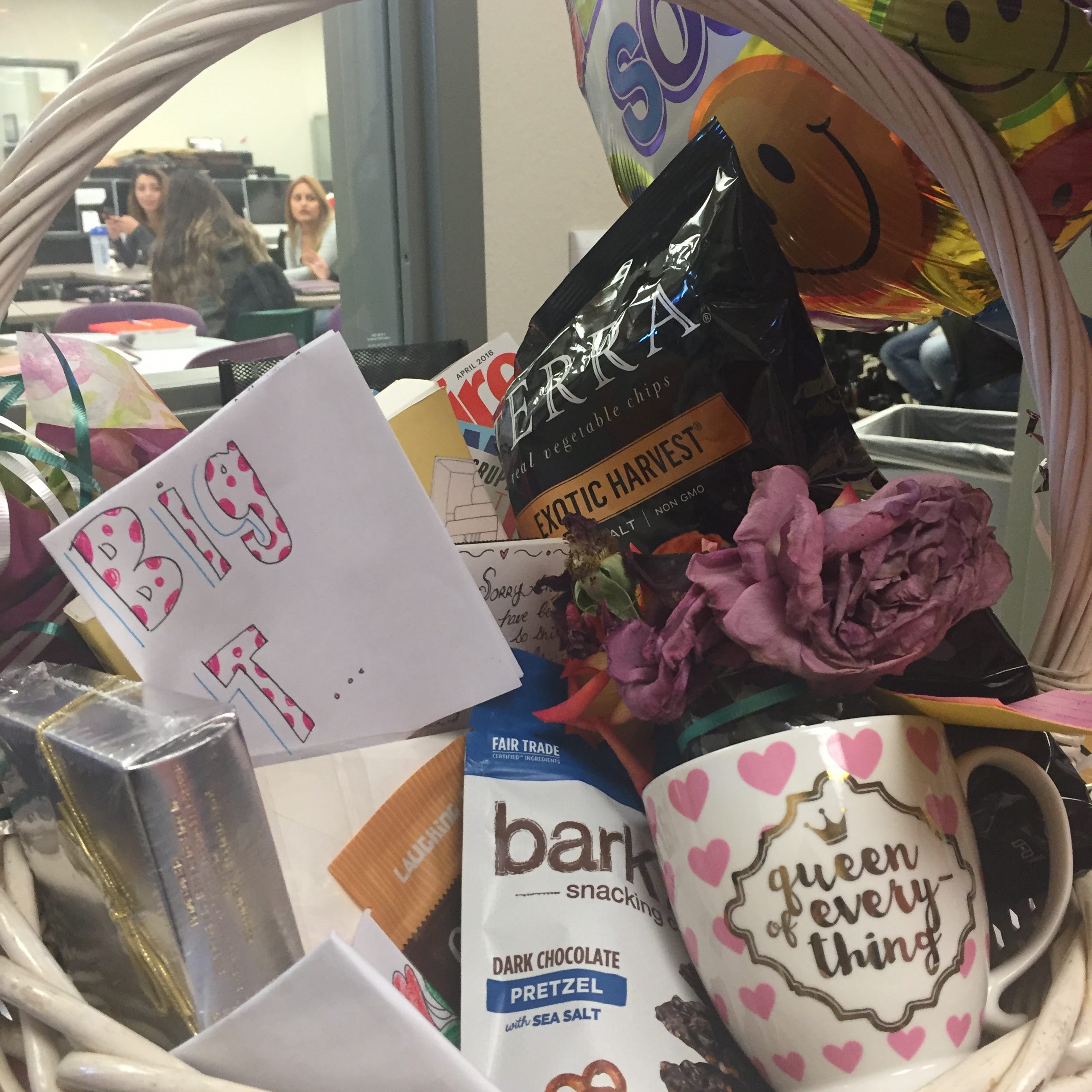
One morning I walked in to find a basket on my desk. Notes. Flowers. Snacks. Chocolates. A candle. A coffee mug. Balloons. And sitting next to it, a framed photograph of my student who had posed as Frida Kahlo for a photo shoot, shot by another student, and on the back, a handwritten Frida quote:
“I leave you my portrait so that you will have my presence all the days and nights that I am away from you.”
That photo still sits on a shelf in my living room, and most mornings I drink my coffee from that mug. Both are still with me because someone saw me in the middle of the hardest thing and decided to do something small. And that small thing held me up.
A napkin on a tray. A basket in a newsroom.
I think about my mother often when I catch myself being the angry one, laying on my horn on the 405 when someone cuts me off, canceling a lunch because I was too busy, not knowing the person on the other end needed a shoulder that day. My mother had a patience I have never fully inherited, a capacity to give people a break that I am still, at this age, working toward. Whenever we complained about someone or something, she would stop us with the same reminder, a quote by Helen Keller: “I cried because I had no shoes until I met a man who had no feet.” I understand it now.
Small things. Gratitude. That’s what I keep coming back to. Not grand gestures or carefully chosen words or the perfect thing to say. Just the willingness to stay in the room and try again. To reach across the aisle even when you’ve already been told no.
I don’t know the rabbi’s name. I don’t know the angry man’s name. I’ll never see either of them again. But I think about that flight more than I think about a lot of things, and I’ve decided it was one of the more important things I’ve ever witnessed at thirty thousand feet. Given how much I dread being up there, that speaks volumes.
We are all carrying something. We all have our El Guapos, our impossible thing, our heavy load, our worst day wearing our face in public. The rabbi knew that. My mother knew that. I’m still learning it.