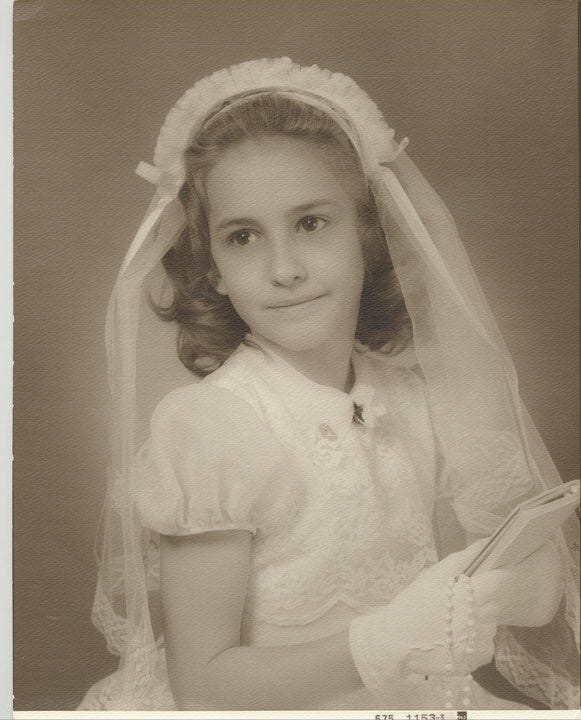
I was baptized into the Catholic Church before I had any say in the matter, which is how the Church prefers it. A few years later I made my First Communion in white gloves and a dress that made me look like a small bride, receiving the body of Christ for the first time with the solemn expression of a child who had been told many times that this was not a snack.
Then came Confirmation, the sacrament where you choose your own saint’s name and the Church considers you a full adult in the faith, which is a lot of responsibility to hand to a twelve-year-old. I chose Teresa because it sounded good with Toni.
Every Sunday we went to Mass. Someone had to pray for my father’s sins. That job fell on our mother, my sister, and me.
I attended Catholic schools from first grade on, where the nuns taught me that God was watching, that suffering was holy, and that I should say this prayer every single night before bed: Now I lay me down to sleep, I pray the Lord my soul to keep. If I should die before I wake, I pray the Lord my soul to take.
I was six.
IF I SHOULD DIE BEFORE I WAKE.
I haven’t slept well since.
I pray often now, in the car, in the shower, and walking past the saints on my shelf. I carry Holy Water in my bag and sprinkle it on my family without their knowledge. I say the Hail Mary like a mantra in the dark when I can’t sleep, which is most nights.
But I’m not religious. I guess I’m just covering my ass, in case.
I no longer go to Mass and I don’t confess my sins to a priest, which would take considerably longer than it used to. I show up for the big ones like Ash Wednesday, when I let a priest drag his thumb across my forehead and then walk around all day with a grey smudge between my eyes like a woman who has reconsidered her life choices. And Palm Sunday, because I bring the palms home and tuck them into the hands of the saints and pass them to the sinners in my family who chose not to sit through the longest Mass of the year. Easter and Christmas have fallen through the cracks, which is strange considering how important these two holidays are to Catholics. I think the Easter Bunny and Santa Claus stepped in and took over for Jesus.
My best friend, also Italian, and I once made a solemn pact to attend Sunday Mass every week and become, finally, the good Catholics our parents always believed we were. The truth is we had heard there was a thriving Catholic singles group at an upscale church that was nowhere near our neighborhood but had a solid congregation of eligible men and a restaurant that served a boozy brunch directly across the street. She was single and looking. I was dating my now-husband, who at the time came with enough baggage to require its own storage unit, so I figured I could do double duty: support my best friend in her search for love and pray for his soul at the same time. Two intentions, one Mass. I’m all about efficiency.
Mass let out at 11:30, brunch started at noon, and somewhere between the Holy Spirit and the hollandaise, Mimassa Sunday was born: Mass followed immediately by mimosas, a tradition we kept up considerably longer than the actual religion. What ended it for good was an old priest who used his homily to explain that gay marriage was a sin. This is the fastest way to turn two Italian liberal women into former Catholics who are now day-drinking without the Mass part.
Not attending Mass on Sundays doesn’t mean I don’t have my rituals.
Every time I board a plane, I carry a plastic bag filled with Holy Water and small bottles of vodka, and just before takeoff I bless the pilot and the flight attendants (without their knowledge), myself, and my husband.
I have a personal relationship with Saint Anthony, the patron saint of lost things, which makes him perhaps the most universally beloved and most frequently pestered saint. Lose your keys? Saint Anthony. Lose your wallet? Saint Anthony. And then there’s Saint Joseph, who you call on when you need to sell a house. You bury a small statue of Saint Joseph in the yard, upside down, near the For Sale sign. I’ve done this and the house sold. But when I'm really desperate, I call on the lesser-known saints, because the popular ones, like Saint Jude, patron saint of lost causes, are swamped.
My home office has a shelf with fifty-three saints and several wooden and glass crosses. When I walk past my saints, I touch the top of each one’s head. I don’t know exactly when this started. I also have at least a dozen sets of rosary beads. This extensive devotion collection has come from antique stores, estate sales, dead relatives, and the occasional gift from my daughter, who has become an expert at finding vintage Italian saints. Some are beautiful and some are a little terrifying, like the Virgin Mary that lights up or the blown-out egg with the Virgin Mother inside.
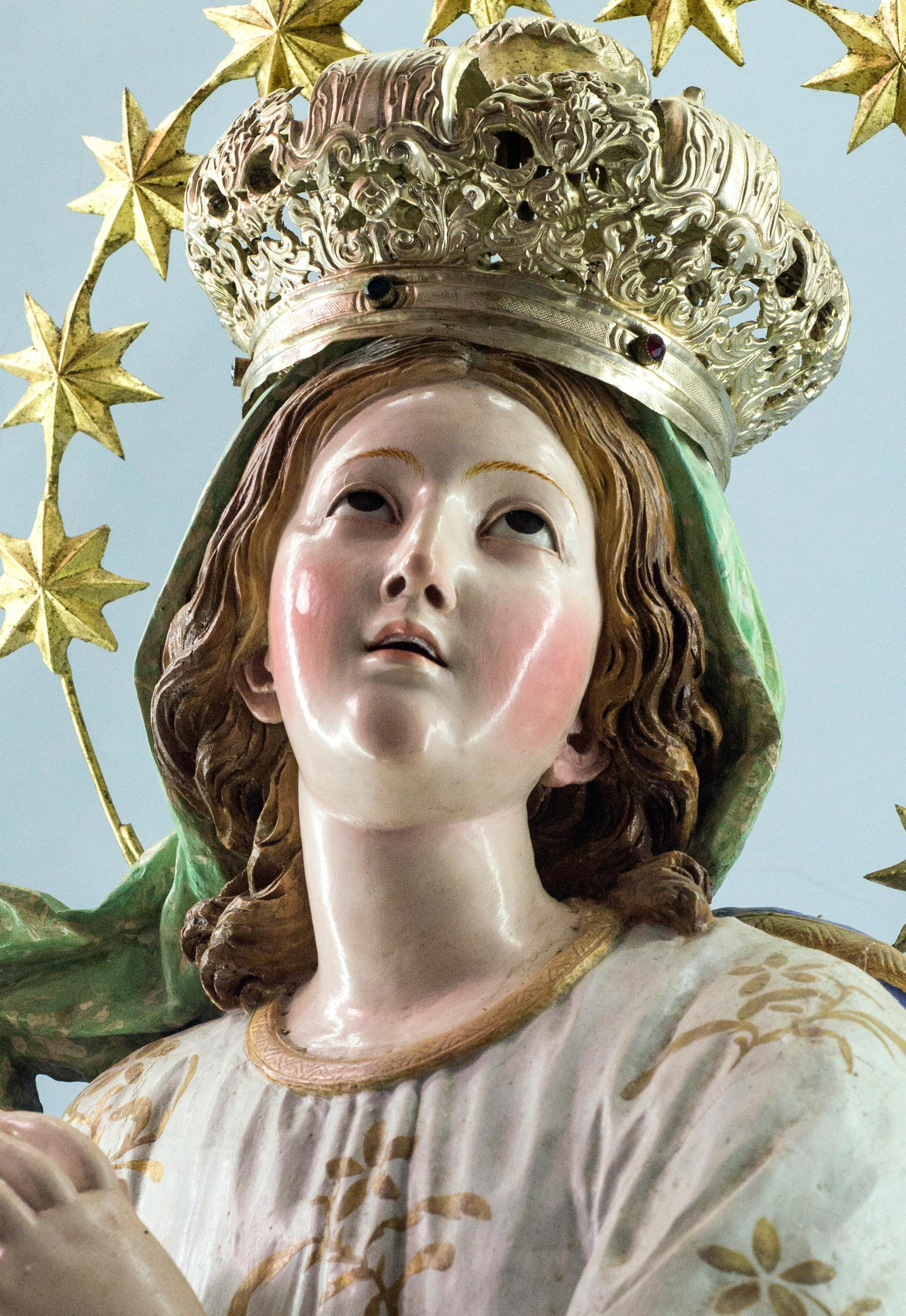
There is also a gigantic statue of the Virgin Mary wearing a large gold crown that I bought from an antique store in New Orleans. I’m convinced she has secret powers. Weird things have happened around that statue. I won’t go into it because it gives me nightmares, but let’s just say that my dead mother appeared in my French Quarter hotel room right after I bought her. I swear it wasn’t a dream. Heading home, I never understood the stares I got going through airport security. Doesn’t everyone fly with a three-foot saint?
When my Aunt Mena died, I carried two gigantic statues of Christ and Mary on a train from Connecticut to New York, then onto a plane back to California, those saints riding with me like ceramic bodyguards. I’ve never felt so safe flying. My birthday and Christmas lists all have the same thing, right after the Fendi baguette and the apartment in New York: Vintage saints from Italy.
It’s not unusual for my daughter to call me from a thrift store or an estate sale.
“Hey Mom, there’s two church pews here and a big painting of the Virgin Mary. You interested?”
I’m always interested.
There are also the broken ones. A ceramic cross with a chip along one arm. A saint missing his hand at the wrist, Saint Francis, I think, though at this point he has enough company that he doesn’t seem lonely. A small Madonna whose base cracked through in a move. Broken sacred things are still sacred. Maybe more so. They carry the evidence of a life lived around them, maybe a fall from a shelf, a move across the country, or the chaos of a family that didn’t always handle things gently. I keep them alongside the intact ones, or in my herb garden next to my ceramic Buddha.
It’s not just the saints; it’s all of it. The old churches and dark pews worn smooth by a hundred years of wool coats and nervous hands. I can’t visit a city without visiting an old church. The lasting smell of incense smoke trailing from a thurible swung on its chain, filling the vaulted air like a secret the walls have been keeping for centuries. The hallowed quiet of a space where people have been bringing their worst fears and desperate requests for generations, pressing them into the kneelers. The candles I light, usually asking for the safety of my family, or safety on the flight home.
I don’t know exactly what I believe about God, but I believe completely in the smell of incense and the irrational comfort it delivers, something that tells me what I need to hear: everything is fine, no one you love will die, and there is probably pasta afterward.
My office wall holds the writers and women I pray to in the secular sense — quotes from my favorite writers Nora Ephron and John Patrick Shanley, and a gigantic framed photo of Joni Mitchell given to me by my sister that hangs above my white faux leather sofa. Joni watches over everything. She is my personal saint. Saint Joni.
My husband’s friends walk into my office and a particular look crosses their faces. I’ve decided it means they think his wife is one saint away from an intervention.
My white desk sits behind the shelf of saints on a large white faux fur rug. Seven old paintings of saints are propped against another wall, all collected from estate sales, each one carrying the weight of having hung in someone else’s house of grief. One is signed by several men in Italian. I’m convinced they may have been priests, or saints themselves. There is also a child’s rocking chair from Italy that I am convinced rocks on its own.
Yes, I know how it sounds, and no, I’m not changing anything.
At night, I calm myself by saying a full rosary, no beads required. After a lifetime of Masses and funerals, the words come up on their own, the way an old song does. Do I think anyone is listening? Honestly, I’m not sure. But as Joni Mitchell sings, I sent up my prayer, wondering who was there to hear.
The fear of death is not something I’ve outrun. It lives in me the way the smell of incense lives in old churches, absorbed into the walls over decades. My saints are not decoration but company. They are the comfort of objects that have been touched by loss and prayer and time, that have stood on someone’s dresser while someone prayed beneath them. They have passed through the hands of people who are gone now. My daughter finds them for me. My family has given them to me. Some came from people who died, which means they carry a residue of devotion, the trace of hands that touched them before mine. Even the broken ones.
My Nonnie put quarters under hers and prayed in Italian. I touch their heads and pray in English. I don’t know if it works, but I believe someone is listening. I’ve had too many prayers answered not to.
My name is Toni Ann Teresa, and I’m not crazy.
I’m Italian.