

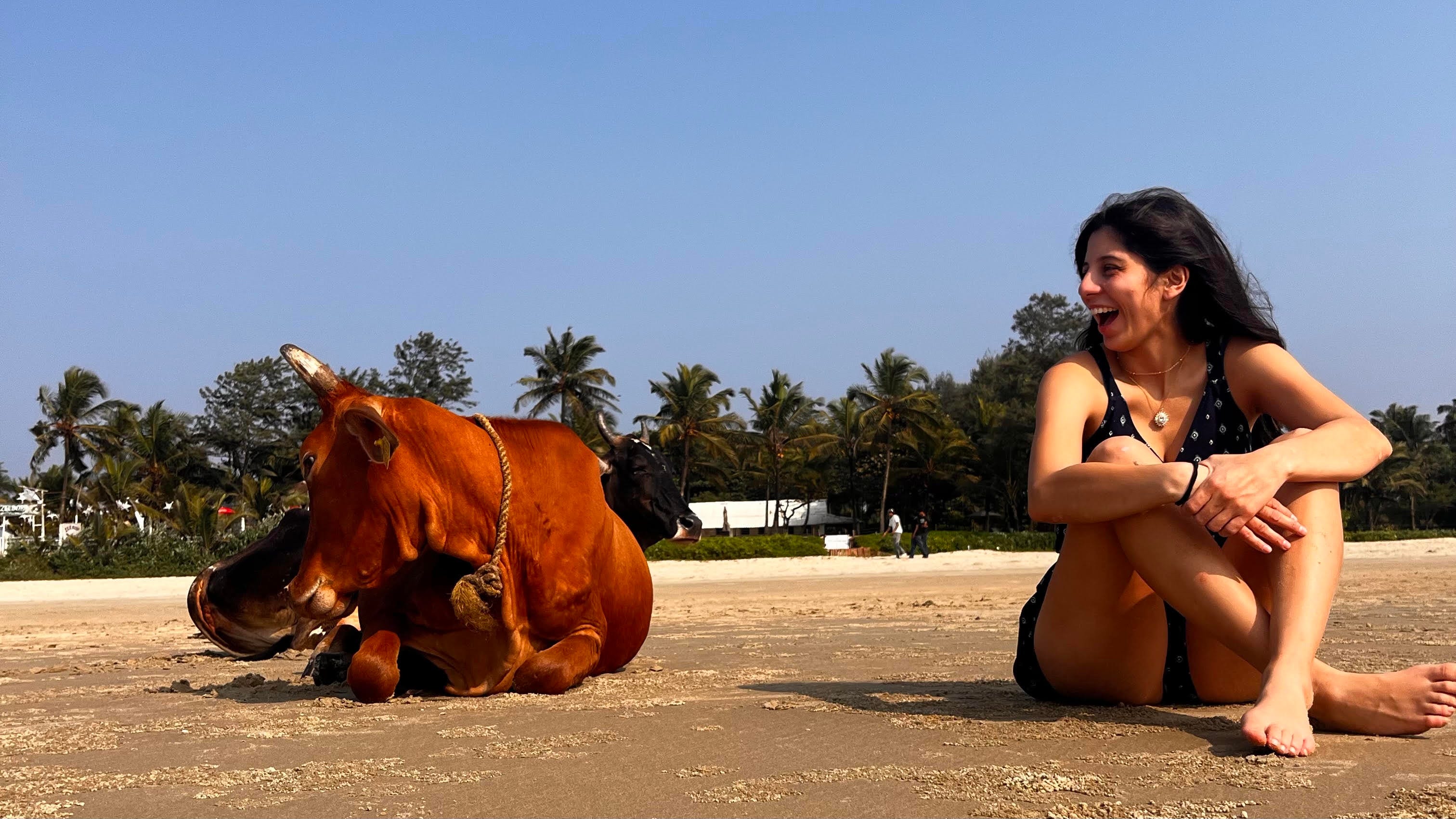
Kassandra Ruiz’s last thought on that road outside Chiang Mai, in northern Thailand, drifted in slowly and dreamily, as if she were watching it happen to someone else.
Wow, that truck is getting kind of close.
Everything went black. The next thing she felt was asphalt against her back, her eyes sealed shut, her body refusing every order she gave it. What came next surprised her more than the truck did. A voice started up in her head, steady and low, the way you would talk to a frightened animal.
“Okay,” she told herself. “You can’t move right now, but you’re okay. Just give it a minute. You’re going to be okay.”
She gave it a minute. Then she jumped to her feet, blood gushing down her face, and turned to Jessi, the Austrian woman she had met a few days earlier, who was frozen on her own motorbike at the edge of the road.
“What happened?” Kassandra shouted.
“You just got hit by a truck!”
Kassandra thought about that for exactly one second.
“No way,” she said. “I survived that!”
It was the spring of 2023. She was 24, and she had never ridden a motorbike until the day before. Within the next few hours, she would refuse an ambulance, try to fill up her gas tank with a broken nose, talk her way out of a hospital stay, and show up that same night ringside at a Muay Thai fight with her discharge papers in a plastic bag.
When she tells the story now, she laughs at the girl in it. She also knows that girl almost didn’t make it home.
Kassandra is 28 now and lives in Vietnam, where she teaches English. She has long brown hair and a smile people remember. She is so petite that it’s hard to picture her walking away from a truck. Five years on the road have left her with an accent that is hard to place, part English and part everywhere she’s been. Years earlier, in college, she was the student who told an entire classroom she just wanted to travel the world and write about it.
Before any of that, there was the name.
For most of her life, she was Kassandra. Then she left California for a job at a summer camp in Massachusetts, and the onboarding form asked for a nickname with no option to leave it blank.
“Well, sometimes people call me Kassy, like once in a blue moon,” she said. “So I typed it in, and they printed it on my name tag.”
It stuck. Everyone she met after that knew her as Kassy, and over time the two names split into two people.
“It feels almost like an alter ego,” she said. “Kassandra is me in California. Kassy is adventurous me. Post-California me.”
For the record, she likes Kass best.
Both sides of Kassandra’s family came from Mexico. Her mother’s people are from Michoacán, her father’s from Zacatecas. Her mother, Maricela, got pregnant at 17 and had three children by 22, two older brothers and then Kassandra. A younger sister, Isabella, came 10 years later.
Her mother worked constantly. That is the first thing Kassandra says about her, and she says it with respect.
“She is such a hard worker. I’ll never take that away from her,” she said. “But I do remember as a kid, she was gone all day, and by the time she came home, she was so tired.”
Kassandra watched her mother go through the same cycle day after day, too tired to do anything else.
“I always told myself, if I could, that’s not really what I want,” she said.
That fear stayed quiet until her second semester at Mt. San Antonio College, a community college about 25 miles east of downtown Los Angeles. Her first semester went beautifully: business major, 3.5 GPA, everything on paper pointing toward a bright future. Then she took her first business administration class.
“My heart just sank,” she said. “If I go through with this degree, does that mean I’m going to end up in an office clocking in nine to five, and that’s me for the rest of my life?”
She didn’t drop her classes; she stopped going. Some professors dropped her, others failed her, and the 3.5 GPA student landed on academic probation. To keep anyone at home from noticing, she left the house every morning as if she were headed to campus.
“I had no idea what I was doing,” she said.
What saved her was working at a local ice cream shop. A coworker mentioned she was going to Europe in August. Kassandra went home that night, looked up flights, and found one that fit her budget. Then she started calling everyone she knew. A cousin said yes, and a few weeks later they landed in London.
“London is one of the most special cities in the world to me,” she said, “because it’s the first place I ever felt like I independently traveled somewhere.”
On a coach bus to Stonehenge, a group of young Europeans started teasing the two Americans about the cost of college back home. Then one of them mentioned that an undergraduate degree in Germany was free.
“I was like, no way,” Kassandra said.
She came home, ignored every class at the college except one, and signed up for German. She planned to spend one summer becoming fluent enough to enroll at a German university.
“That did not happen,” she said. “I did not become fluent enough.”
But she got close to her German professor, and one day he asked her a simple question.
“So what do you want to do in life?”
“I have no idea,” she told him.
He invited her to office hours. After a long conversation, he suggested sociology and journalism. She took his advice and enrolled in those classes.
It was the right fit. Her journalism adviser and the student media editors saw her talent for telling stories, and she became a valued member of the student media staff. One day, her journalism professor asked the class what each of them wanted to do with their lives. This time, at 19, Kassandra didn’t hesitate.
“I just want to travel the world and write about it,” she said. “That’s my dream.”
Her professor didn’t laugh or nudge her toward something safer. She loved the idea and told her to go for it.
What few people saw was how much she was carrying. She was working about 35 hours a week to pay for school. She was also, in practice, raising her little sister.
When her sister Isabella was a small child, she announced that she wanted to learn piano. Kassandra, 18 and earning her own money, signed her up for lessons. Isabella lost interest. Then she wanted to be a photographer, and Kassandra started saving for a camera until Isabella changed her mind again. Then she wanted to play sports.
Kassandra was hoping for basketball. Isabella chose soccer, so she called their mother.
“Why are you asking for my daughter’s birth certificate?” her mother said.
“Because she wants to play soccer,” Kassandra said.
She told her that she would take care of everything. She drove Isabella to practice, sat through every weekend game, and never missed one. She was a full-time student and nearly a full-time employee, and she felt, in her words, “almost like a part-time mom.”
Kassandra transferred to Cal State Long Beach University and graduated in December 2020 with a bachelor’s degree in sociology and a minor in journalism. Then she did what a lot of graduates do. Nothing.
Her mother came home one day and stood over her.
“You’ve got to do something with your life,” she said. “I don’t want to come home and see you lying on the couch.”
Kassandra said it’s one thing to talk about traveling and another actually to do it.
“I was really scared to take that step,” she said. “It’s easier to dream about something.”
She took a job in social media marketing, and she liked it. She also accepted a summer job at a camp in Massachusetts. Her first choice was Germany, but COVID had closed that door, and Massachusetts was about as far as anyone could go without a passport. For weeks she swung back and forth. One day she was staying to buy a plot of land, build a house, and start collecting assets. The next, she was leaving.
“Everyone does that, and it’s smart. It’s very responsible,” she said. “Most people don’t just go rogue in their life, and I didn’t know anybody personally who had done it. I’d be the first one, and I didn’t have anyone to guide me through this.”
Then she would argue with herself.
“Worst case scenario, you mess up, you come back, you’re broke, and you start all over.”
It took two people to tip her over the edge. The first was her cousin Saria, who had become a loan officer at 19 and was earning six figures before most of her friends could legally drink. On hikes through Chino Hills, in San Bernardino County, they talked about money and what it was for.
“She said that everyone comes in with a Rolex, but they don’t actually live,” Kassandra recalled.
Saria told her to watch Into the Wild, the film about Christopher McCandless, a young college graduate who gave away his savings, left everything behind, and set out across America.
“That movie completely blew my mind,” Kassandra said. “It was the movie that made me book the flight. I’m leaving.”
The second was a backpacker named Ruben, about 30, whom she had met on an earlier trip. Over a weekend in San Diego, she laid out her dilemma. Stay and build something stable, or leave and figure it out.
“Look,” he told her. “I’m not as rich as anybody my age, but I’ve got experiences that people die dreaming of. I wouldn’t sell that for all the money in the world.”
She still messages him about it.
“That one sentence made me want to leave,” she said.
Around the same time, while still at her marketing job, she wrote a blog post she called “Untimely Death.” In it, she described fear as the space between herself and a door, and asked whether she would open it and breathe the air of an unexpected world.
She opened it. The flight was to Massachusetts, for a summer job at the camp, but she knew it was more than that.
“Buying that flight meant I was going to work that summer contract and then figure it out and live nomadically,” she said. “Just leave everything behind and not come back.”
The hardest part of leaving was Isabella.
“She was the number one reason I felt like I couldn’t leave,” Kassandra said. “Is she going to be okay? My mom works all the time. She’s a single mom.”
The timing made it worse. Not long before, one of her brothers came home and announced he’d joined the Army and was leaving in two weeks. Months later, Kassandra left too. A house that had been full of people emptied almost overnight.
A friend gave her advice she didn’t want to hear.
“If you’re there, your family is always going to use your help,” the friend said. “You just need to trust that when you leave, they’ll figure it out.”
They did. Her mother, who had previously told her daughters she couldn’t promise to show up to games, started coming when she could. Then she started enjoying it. Eventually she became the team manager for one of Isabella’s soccer teams.
“Whoa, this is crazy,” Kassandra said. “I think my mom’s really grown. And I think she and my sister really bonded through it.”
Isabella just turned 18, and she recently signed with USC on a cross-country and track-and-field scholarship. Soccer helped her discover her athleticism, but in high school she shifted her focus to running. Kassandra watched the video of her signing the paperwork and cried.
Kassandra’s road started in New England and spread from there. She lived nomadically around the Northeast, then followed a set of English friends to Europe, then backpacked through Eastern Europe on her own. Since then she has been to Morocco, Egypt, India, Sri Lanka, Laos, Thailand, Peru, Guatemala, Jamaica, Australia, South Africa, Ireland, and more. She has stood on six of the seven continents. Only Antarctica is left.
People assume she’s rich. She laughs about that.
“I don’t come from a family that has any money,” she said.
In the early years, she counted every dollar. She couch surfed and ate one meal a day when she had to. A fellow traveler taught her to look for the cheapest food with the most calories. Some nights she went to bed hungry on purpose so she could skip dinner and eat in the morning.
“I’d rather walk two hours than pay for an Uber,” she said.
She has slept on a beach. She has slept in her car all across America. The strangest night came in Brussels, when every hostel in the city was booked. The only option left was a fancy hotel for more than $100, so she curled up in a hotel stairwell instead.
There was also what she now calls her scandalous phase. She explained:
“I have literally walked into hotels in the morning, pretended to be a guest, and eaten their continental breakfast. I’d say hi to everybody and have a nice chat. I met some lovely hotel workers, and they totally thought I was staying there. Then I ate the breakfast, walked out the door, and never saw them again for the rest of my life.”
She pulled it off two or three times, but said she probably wouldn’t try it now.
“It gives you an idea of just how extreme I took things,” she said. “All for a couple of extra days to travel.”
The money came mostly from Massachusetts. The camp is a nonprofit run by an English couple who traveled the world before settling in the States. It offers free tuition to foster kids and serves adults with disabilities. Staff live on site and are fed. The pay is low, but with rent and food covered, Kassandra figured she could save about 80 percent of what she earned. On weekends she worked in restaurant kitchens. She had no kitchen experience when she started, but she has since learned to cook.
“I walked in there knowing nothing,” she said. “I learned on the job when I was hired as a professional.”
After her second season at the camp, she asked the directors if she could store her things in their basement while she traveled. She still doesn’t know where she found the nerve to ask, but they said yes. Then they told her she would always have a place to live and work whenever she came back. That arrangement became the pattern of her life: travel until the money ran low, return to Massachusetts, work, leave again.
Her first trip outside the West was Morocco, and it began badly.
She flew in at night straight from a Christmas spent with a new friend in England, a woman named Heather who would become her best friend. Trying to save money, she skipped the taxi and waited for a public bus while men shouted at her from the roadside, offering rides. The bus driver yelled at her for trying to pay in dollars. When she couldn’t find her hostel in the maze of alleys, she showed a stranger the name on her phone. He motioned for her to follow him into a dark alley.
“We just kept going corner after corner, and I was thinking, I’m in his hands right now,” she said.
He stopped and pointed at a door. It was her hostel. The hostel had advertised that it took credit cards. It did not.
“He said we’re gonna sell the bed to someone else,” Kassandra said.
She told him she had nowhere else to go, dug through her bag and found a five-dollar bill.
“Sir, please, can I give you this five-dollar bill? I’ll figure out the rest tomorrow.”
He let her stay, and she went upstairs, climbed into her bed, and exhaled. A German backpacker walked in and yelled at her that she was in his bed. After the staff sorted it out, she climbed onto a shabby little rooftop terrace and called Heather in England.
“Hey, mate,” Heather answered. “How are you?”
Kassandra burst into tears.
Morocco wasn’t her first scare. She tends to mention the near-kidnapping in passing, tucked into the middle of another story, as if it were a minor detour.
She was in Munich, trying to get to Vienna as cheaply as possible, and chose BlaBlaCar, a ridesharing service she describes as “organized hitchhiking.” Drivers post their routes, and passengers split the gas. Everyone who recommended it was a man.
“Well, if a guy can do it, I can do it too,” she said.
The ride cost about 10 euros. The driver was in his 40s and spoke little English. She shared the car with two young men, one German and one Austrian. At a rest stop halfway there, Kassandra’s phone buzzed. It was a text from the driver.
Would you like to go with me to steak dinner tonight?
“Me being me and not having any money, I had to think about it,” she said, laughing. “A free meal? And then I realized, no, that meal is definitely not free.”
She got back in the car and said nothing.
In Vienna, the driver dropped off Felix first, the passenger who lived in the city center. Kassandra’s hostel was also in the city center. Instead of letting her out, the driver headed for the suburbs to drop off the second passenger, Joscha.
“Logistically, it didn’t make any sense,” she said.
At the second stop, she got out to hug Joscha goodbye, and when she got back in, she took the front passenger seat. If anything happened, she wanted to be able to open the door and jump.
The driver didn’t start the car. He typed into Google Translate and held up the screen.
Would she like to go to a steak dinner with him?
“Oh no, it’s okay,” Kassandra said. “I’ve got plans with Felix.”
He tried again. She could drop her bags at his hotel, see Felix, and come back. She could stay with him the whole time she was in Vienna.
“No, no,” she said. “I booked a place, and I would really like to stay there tonight.”
He made a disgusted sound and hit the gas.
Kassandra pushed her bags to the floor, set her Hydro Flask in her lap, and gripped it. She opened Google Maps and watched the blue dot. If he turned the wrong way, she was going out the door. Then she texted Heather.
LOL. Might be getting kidnapped right now.
“What are you talking about?” Heather wrote back.
Kassandra shared her live location. From England, Heather watched the dot move across Vienna. Heather still has her location today.
“I’m very calm in chaos,” Kassandra said. “I never react the way people would expect.”
The driver turned down a side street, and Kassandra’s hand clenched the bottle. She started cracking jokes in broken German. She doesn’t remember what she said. Then the car swung back onto the main road and pulled up in front of an IKEA. Her hostel was on the top floor.
“We’re here,” he said.
She grabbed her things and was out of the car, shaking.
“I didn’t really process it,” she said. “I checked in and put my things down, and then I took a second and was like, oh my gosh. That guy had bad intentions, and he was thinking about it the whole time I was in that car alone with him.”
She told the story in her dorm that night. People climbed out of their bunks to hear it. By the next morning she had a walking group, and a few days later she was in Budapest with them having, as she puts it, the night of their lives.
Back to Thailand, and to the week before the truck incident.
Kassandra arrived in Bangkok on what she calls “cloud nine.” She visited temples, wandered the night markets, and ate bugs even though she hates them. One morning she met a young Austrian woman named Jessi and two travelers from England. The four of them formed a travel group, and by that night she had a proposal for them.
“I’ve always wanted to blindfold myself and let other people tattoo anything they want on me,” she told them. “My best friend won’t do it, but you guys don’t know me well enough to care.”
They found a tattoo parlor, and she gave them two rules: The tattoo had to go on a certain spot, and it had to be small. Beyond that, she said, just be respectful.
“They kept joking that it was going to be a penis,” she said.
She waited on the sidewalk while the three of them huddled up behind the glass door with the tattoo artist. Then they waved her in. Someone pulled a COVID mask over her eyes. She lay back and listened as they narrated fake designs while the needle worked. When it was done, she pulled the mask off and looked down at her foot.
It was a small elephant, for Thailand.
“They told me they almost put their initials on me,” she said. “That would have been bad. You guys are really cool, but I just met you.”
From Bangkok, the group headed north to Chiang Mai. Kassandra had just come from India, where the traffic made Thai roads look orderly, and she was eager to ride. She rented a motorbike from her hostel after a five-minute lesson. Nobody asked for her passport. That first day she carried Jessi on the back to a temple and to lunch, wobbling the whole way and keeping quiet about it.
“Thank goodness nothing happened there,” she said. “You’re just so full of life that you think you’re invincible.”
The next morning they rode out on separate bikes, headed for an elephant sanctuary about an hour outside the city. Twenty minutes in, Kassandra spotted a gas station across a four-lane road. She pulled into the turn lane to make a U-turn, and the traffic didn’t let up.
“I’m the one who gets impatient,” she said.
She saw an opening in the lane next to her and went, but she didn’t know yet how to make a tight turn on a motorbike. She drifted wide, into the third lane. She didn’t know to brake. A truck was coming.
Jessi filled in the rest later. Kassandra hit the truck and went down face first. The driver pulled over, handed the bike to Jessi, and rolled Kassandra onto her back. That’s when they saw all the blood. For about a minute and a half, she didn’t move, and Jessi thought she was dead. Then her arm lifted and lay on her forehead. Thirty seconds after that, she jumped to her feet, yelling.
The friendly man who kept helping her lift her bike and asking if she was okay turned out to be the driver who hit her.
“Oh, no wonder he was so nice to me,” she said.
A police officer arrived and told her an ambulance was coming. Kassandra, an American with very little money, was terrified of the bill.
“I’m awake, I’m talking, I don’t need an ambulance,” she told him. “Plus, I need to go see some elephants.”
He refused to leave until she agreed to go to a hospital. She promised to take a Grab, the Southeast Asian version of Uber. Then she climbed back on the motorbike, rode across to the gas station, and asked the attendant to fill the tank.
Jessi started laughing.
“Why are you putting gas in your motorbike?”
“I don’t know,” Kassandra said. “That was the last thing I was trying to do, so I’m doing it.”
She FaceTimed Heather, who was waking up in England. Heather saw her face, and her mouth fell open.
“Dude,” Kassandra said. “You’re not gonna believe this. I just got hit by a truck.”
Kassandra told Jessi she didn’t have to come to the hospital.
“She just watched a near-death accident in front of her,” Kassandra said. “I didn’t want to derail her more than I already had.”
She picked a hospital by typing “hospital” into the Grab app. When the staff ran toward her bloody face, she backed away.
“Do not touch me. How much is this going to cost?”
They couldn’t say until they assessed her, they told her, but it was a private hospital.
“Can you please map me to the nearest public hospital?”
At the public hospital, they did X-rays and an MRI and then left her in the emergency room for hours. She waited so long that the blood dried on her face. Eventually she found a nurse and asked for supplies so she could clean it off herself. Then a doctor came by with the results. She had broken the small bones of her nose and probably had a concussion. He recommended she stay overnight for observation.
She signed herself out.
“I’m in a hostel. I’m not really sleeping alone. If something happens in the middle of the night, they can call the hospital,” she said. “I chalk it up to being younger and dumber.”
She had plans to go bungee jumping with a friend named Nile later that week, so she called to cancel. Then she asked if he was still going to the Muay Thai fight that night.
“You don’t have to go,” he said. “You just got hit by a truck.”
“Nile, I’ve just spent all day in the hospital,” she said. “The last thing I want to do is go home and cry about it.”
In the group chat, Jessi said she’d seen enough blood for one day. Then Kassandra wrote that she would be there.
“Well,” Jessi replied, “if the girl that got hit by the truck can be there, I suppose I can go too.”
Kassandra arrived with a swollen face and her medication in a hospital bag. After the fight, she posed for photos with the boxers. She felt like she was flying.
“When you hit low, you just go straight up after,” she said.
The total bill for the MRI, X-ray, cleaning, and medication came to about $200.
The real cost showed up later.
“When you have a near-death experience, you start to question, ‘Why was I saved?’” she said. “Why did I not die? What’s my purpose? What am I actually doing? That festered for a long time.”
Fall of 2024 was the bottom.
Kassandra was 26. She had flown to England to see Heather, then on to Italy, then to Barcelona, where she planned to start the Camino de Santiago, a pilgrimage route across northern Spain that the camp directors in Massachusetts had talked about for years. In Barcelona, she walked about 20 miles in a day, up and down the city. She stood in front of the Basilica of the Sagrada Família and felt nothing.
“It looked so beautiful,” she said. “But once the dopamine stops hitting, the adrenaline only goes so far. What was exciting initially is no longer exciting.”
She knows how it sounds.
“This is definitely coming from a privileged place,” she said. “But at times it feels like a drag to have to wake up in the morning to go ride a camel. And that’s when I knew. If I’m exhausted by having to wake up and ride a camel, and that’s my day, what am I actually doing with my life?”
She called Heather from the street, crying.
“I don’t think I can do the Camino right now. I don’t know where to go. I don’t know where to live. I don’t know what to do.”
“That’s okay,” Heather told her. “You can come to England and stay here for a bit.”
Kassandra said no. She wasn’t going to bunk on a friend’s couch until she figured things out. Heather stayed on the phone while Kassandra did something she seldom did. She called an Uber.
“That’s how poorly I was doing,” she said.
She rode to the Barcelona airport and bought a one-way ticket to the States. She went straight to Massachusetts and back to work.
“If I’m going to be sad,” she said, “I better be making some money.”
Somewhere along the way, Kassandra developed a private rule about the people she meets on the road.
“If I meet a traveler who has been to more than 25 countries, chances are that person is not doing well,” she said. “They usually have a reason.”
A young Austrian she met later in Sri Lanka put it plainly. He was heading home after his trip, back to a life he liked. Forever travelers, he told her, aren’t happy at home, and that is why they keep moving.
“Yep,” Kassandra said.
She has a name for what she was doing.
“I’m not a drug addict. I don’t do drugs,” she said. “But it felt like I was doing drugs, like I was numbing something. Travel has always been my drug.”
When asked what she was running from, she didn’t dodge it.
“I know why I’m running,” she said. “There was stuff from my upbringing that had consistently been a struggle. It’s something I still struggle with today.”
She said her father played a part in it. He struggled with drugs and alcohol, and the family lived inside that struggle until Kassandra was 13, when her parents finally split.
“At the age of five, I knew I didn’t like my dad,” she said. “My mom would disagree, but I know he didn’t care about me. Someone who brought you into this world couldn’t care less if you were there. That’s definitely impacted me greatly.”
He died in 2019. She never expected a reconciliation.
“When you deal with an alcoholic, they’re gone. They’re a version of themselves,” she said. “I really don’t see any alternate universe where he and I would sit down and have a heart-to-heart.”
She didn’t grieve him the way people expected. She was furious.
“I just remember being like, you never did anything. How dare you die? You died with nothing to your name,” she said. “What a waste of a life.”
It shows up in odd places. Years later, while staying with a friend’s family in Mexico, Kassandra grew suspicious of her friend’s father, a man who drove his daughters everywhere to be with them.
“I had a hard time believing that was true,” she said. “How does a man love his daughters so much? Not because he has to, but because he wants to?”
She has since come around, and realizes he really is a good man and a good father.
“When I meet a really good man, I’m just so touched by it,” she said. “It’s the decent thing to do, but a lot of people make poor choices and choose not to be a good person.”
Her father was not the only wound. As a child, she survived abuse from someone in her family, and she did not feel supported when she needed it most. She worked through it largely on her own, first with a counselor at Mt. SAC, and later in trauma therapy she found through Cal State Long Beach.
It is still the hardest thing she carries.
“It’s everything in combination,” she said. “It makes me feel worthless at times.”
Her relationship with her mother is more complicated. Kassandra is careful when she talks about it.
“She put a roof over our heads and fed us. She was there,” she said. “But because of everything we grew up in, some of her energy went toward my dad and everything he was creating. Sometimes it just felt like I had to be there for myself.”
When Kassandra first started traveling, her mother told her she didn’t understand it. She also told her to go ahead if that made her happy, as long as she never asked for money.
“If you ever get stuck, you can always come back to California,” her mother said. “But I’m not going to support this lifestyle.”
Years later, Kassandra has a theory about what her mother was really thinking.
“She probably thought I’d be calling to come home pretty soon,” Kassandra said. “I don’t think she understood my vision.”
She sees her mother differently now.
“You have a teen mom who had three kids by 22, married to an alcoholic, figuring it out all through her twenties,” she said. “That’s powerful in itself. We were in survival mode, and then all of a sudden you don’t have to be in survival mode anymore, and you don’t know what to do with that.”
Kassandra is working on letting go of questions like why her mother stayed so long.
“As an adult, I understand the emotional tie,” she said. “That’s really hard.”
That Thanksgiving, in 2024, she drove across the country alone to pick Heather up in Los Angeles. It was a lonely drive. She saw places to see and enjoyed none of it. Then they headed through Zion toward the Grand Canyon, on their way to her grandmother’s house in Arizona for the holiday.
The night before they saw the canyon, in a hotel room, Kassandra finally admitted it.
“I’m really just not doing well,” she said. “I’m sorry. I don’t know what I’m doing with my life.”
It was one of the few times she had ever seen Heather cry, and Kassandra felt terrible.
Heather didn’t hesitate. Go to Vietnam, she said. What did she have to lose?
She had a teaching internship lined up in northern Vietnam for January 2025, and she nearly threw it away. She went, but she arrived with nothing left.
The program placed her with a cohort of about 20 young teachers, all of them thrilled to be there. Kassandra barely spoke.
“I was like, I don’t have the energy to talk to people right now,” she said. “Some of my friends later told me, ‘You were really quiet when we first met you.’”
One of them was Chelsea, from South Africa. They clicked immediately. When the group traveled on weekends and had to split up hotel rooms, they didn’t even discuss it. They went to the gym together, ate together, and explored the north together. They watched a drunk man crash his car one night and get carried by his arms and legs to sleep it off beside their dinner table.
“Things that would be insane in America are totally normal here,” Kassandra said.
Chelsea has become family. When Kassandra talks about her, she tears up.
“It’s that warmth I’ve always craved,” she said. “Something I wish we had growing up.”
Vietnam surprised her in another way. For years she had been proud of how independent she was. Getting chased by a would-be kidnapper, getting hit by a truck: she could handle it. She always figured it out.
“Being alone is not hard for me,” she said. “For most people, the challenge is to go off on their own. For me, my challenge is being around people. It’s the inverse. That’s what’s scary.”
She remembers a hike in Wales with Heather years earlier. Heather handed her a pair of good hiking socks so her feet would be more comfortable.
“I told her, no, no, no, you can’t give this to me,” Kassandra said. “And then I just started crying. I can’t believe you would give me a pair of socks.”
That old sense of worthlessness runs deep. Part of her still doesn’t think she’s worth a pair of socks.
“That’s why my story always comes back to people,” she said. “The camp directors, Heather, Chelsea. They didn't do anything out of the obligation of family, but they did everything because they loved me. And that love has transformed me.”
In Vietnam, she started asking people to come along instead of always going alone.
“There’s a lot of beauty in letting yourself fall into other people, letting them support you and be there for you,” she said. “When I was young, I felt like I had to stand up for myself, fight for myself, and prove everything. That was the only way I knew. So now it’s like, how do I let other people support me?”
In September 2025, a year after she stood in Barcelona unable to begin, Kassandra walked the Camino with Chelsea.
The Camino de Santiago is a network of ancient pilgrimage routes that have drawn walkers since the Middle Ages. Every route ends at the cathedral in Santiago de Compostela, in Spain’s far northwest corner, where tradition holds that the apostle James is buried. Pilgrims carry everything on their backs, sleep in bare-bones hostels called albergues along the way, and collect stamps in a small passport to prove they walked it. Some come for faith. Others come to sort out their lives. The most famous route, the Camino Francés, covers roughly 500 miles.
They started in Saint-Jean-Pied-de-Port, a small town in southern France, and followed it across northern Spain toward the Atlantic coast. Kassandra compares the distance to walking from San Diego to San Francisco. It took them 33 days. She carried a seven-kilo pack. They left each morning around seven, late by pilgrim standards, and arrived in the next town by three or four. They showered, washed their clothes, ate, and collapsed.
“Anybody that talks about the Camino can only give you 10 percent of what the experience is actually like,” she said.
She thought she was there for the walk. She met recovering alcoholics, people whose marriages had just ended, people who had lost jobs or burned out. Everyone talked about what was really going on in their lives.
“There’s nothing better than being on a really long walk where all anybody wants to do is talk about the realness in their life,” she said. “Everybody knows everybody’s on their own path. But at that moment, we’re all together.”
One woman stayed with her. She had come to the Camino after her father died, hoping to walk the grief out of her body. By the end, she changed her mind. It wasn’t about getting over it, she said. It was about learning how to live with it.
Kassandra has been turning that over ever since.
“We think peace is this utopian destination,” she said. “But I now realize it’s just the ability to come to terms with your realities. You can’t change what has happened. The sooner you accept them, the easier things get.”
By the time she reached Santiago, she hadn’t seen her family in a year and a half. She is still, as she puts it, in her post-Camino.
“You can’t resolve everything in 30 days,” she said. “But it pushes you in the right direction. I want to build those bridges. Rebuild from the rubble. It’s a work in progress.”
Now she’s back in Vietnam for a second stint, teaching English to primary school children.
“You’re like a superhero at school,” she said.
Her contract ends in May.
For all the hard stretches, she doesn’t want anyone to think the road broke her.
“It’s certainly not fair to say traveling has been tough,” she said. “It’s been so positive. I would never change it for the world.”
She has grown more than she ever could have in California. The road showed her what she calls her greatest strength: the power to overcome. Someone once told her the beginning of your life doesn’t have to determine the rest of it. She is living proof.
“I always knew I was hungry for so much more,” she said. “I knew I didn’t want to stay stuck where I was.”
She has also run two marathons.
“It takes a lot of grit to keep going when things get hard,” she said. “When life knocks me down, I just keep running that marathon. I keep going, and going.”
For her, the meaning of the road always comes back to people. She is chasing the seven wonders of the world, and said it will be cool when she’s seen them all, but added that this isn’t the point.
“Even when I walk outside, and I see a little Vietnamese kid, and I give that kid a high five, I think it’s amazing that I can connect with somebody who’s not from where I’m from,” she said. “Whether that child put a smile on my face or I put a smile on theirs, those small moments are what add meaning to life.”
As for the camel that once felt like a chore?
“I would ride a camel any day I could,” she said. “I would bungee jump if I could. That’s what makes me happy. If that’s my version of not being stuck, then I’ve got to chase what’s out there.”
Kassandra has met travelers of every age and counts many women over 55 among her friends. For anyone who wonders whether it’s too late, she has an answer.
“It’s never too late,” she said.
She talks about a retired teacher in her 60s she met at a hostel in Jamaica, beaming on her way to the beach. And a close friend, also in her 60s, who recently gave up her apartment lease to spend a year on the move. That friend came to visit her in Vietnam.
“She told me, ‘Kass, I’m doing this because of you,’” Kassandra said. “Me? Little me?”
She is careful not to sell the road as a cure.
“Traveling is not the key to happiness,” she said. “It opened a door for me. But I don’t want to inspire people to sell everything and hit the road. That’s not the answer for everybody.”
What she wants is simpler and harder.
“Find your version of traveling,” she said. “What’s the thing on the other side of your fear? What have you been wanting to do that you can’t do because you’re scared? Whatever that is, open that door and walk in.”
She has a book in progress, which she picks up and puts down between countries. She was shy about posting her story on Instagram until strangers began writing to tell her she inspired them. That still embarrasses her.
“From my perspective, I’m just living my life,” she said.
Someone once answered her when she said that, and she has never forgotten it.
“Sometimes living your life is the most inspirational thing you can do.”
Thanksgiving is her favorite holiday, and being on the other side of the world was not going to stop her from celebrating it. Her plan was a small dinner in Vietnam with three friends from the internship: one other American, one Irish, one British. A real turkey would have to be shipped in from the United States, which costs far too much, so they planned to barbecue a chicken and call it a turkey.
Asked what she is most grateful for this year, she didn’t need to think.
“Heather, Chelsea, and my sister,” she said. “Those three people have gotten me through everything.”
To follow Kassandra’s travels and get updates on her book in progress, find her on Instagram at @kassyruiz.
Beautifully told story, Toni. Thank you.
The part that got my tears flowing and my gut hard as a rock was this:
“When I meet a really good man, I’m just so touched by it,” she said. “It’s the decent thing to do, but a lot of people make poor choices and choose not to be a good person.”
Her father was not the only wound. As a child, she survived abuse from someone in her family, and she did not feel supported when she needed it most. She worked through it largely on her own, first with a counselor at Mt. SAC, and later in trauma therapy she found through Cal State Long Beach.
It is still the hardest thing she carries.
“It’s everything in combination,” she said. “It makes me feel worthless at times.”
~. ~. ~. ~. ~. ~. ~. ~. ~. ~. ~. ~.
As cancer has recently made itself known in my feminine parts and all were removed, I can't help but think about the sadness those parts endured at the hands of adult men who thought that I, as a baby, a four-year-old, and an 18 year old was OK to rape. I didn't have memories of much of it until I was in my 40s. Lucky to have had some good therapists and those earliest traumas - once remembered and validated - put me on the road to become a trauma relief bodyworker myself.
Now, as friends reach out with so many cards, gifts, books... to see me through this health hiccup, I can't help but think I've always needed to help others because I was such a damaged nobody - only good for being used and abused. The love surrounding me is hard to accept. Makes me cry. I'm learning to let it in.
Salt tears are the best cleansing agent... they help get out the grief stains.
Thank you, Kassy. Can't wait to read your book! Thank you Toni. Keep writing, please! ❤️