

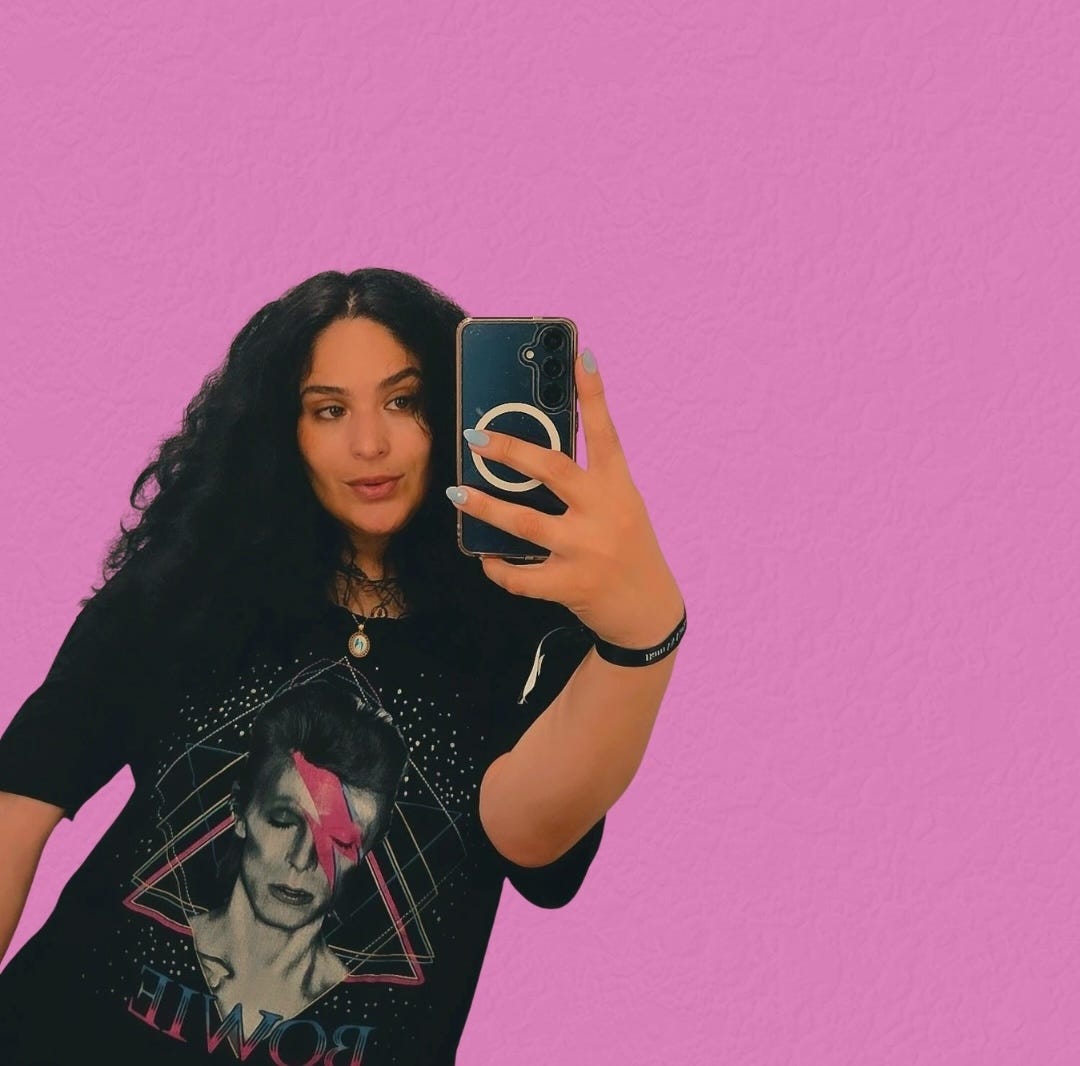
There is a moment, if you spend enough time with Brigette Lugo, when you stop listening to her words and just watch her. The way her hands move when she talks, like punctuation marks with a pulse. That gorgeous smile that gives no warning for the laugh that follows, a laugh so big and loud you can't help but join it. And those long dark signature curls when she turns her head.
Her parents named her after Brigitte Bardot, and people have been telling her she looks like Salma Hayek for most of her adult life. In her own humble eyes, she has never quite lived up to either. Everyone around her would strongly disagree.
What she will own, completely and without hesitation, is this: she is a lot.
It started in kindergarten. She remembers chasing a girl named Ashley around the playground. Ashley would later recall that Brigette was wearing a Barney shirt and kept asking, “Will you be my friend? Will you be my friend? until Ashley finally gave in. They stayed friends through high school and what Brigette remembers from those early years is not so much the friendship, but the feeling around it: the secondhand embarrassment she could see on other kids’ faces just from being near her.
“I’ve always been that way,” she says. “There’s not something I can pinpoint. I was just desperate to have someone there with me.”
The report cards said it all: Talks too much. Every year, without fail. It wasn’t malicious, she’ll tell you. She wasn’t pulling anyone’s hair. She was just being social. Her father eventually developed a signal for restaurants, a quiet gesture that meant you’re too loud. She would look at him with dagger eyes, thinking, How are you trying to control me when at home you have the loudest laugh, the loudest sneeze, and you think everything my mother says is hilarious. She laughs telling the story now. She learned, over time, to modulate in public, but with her people, she lets it go.
“They know that’s part of who I am,” she says. “We’re at a restaurant, we’re laughing, we’re having drinks, and I’m the loudest every time. They just think, ‘This is her.’”
She also shows up in every city she visits before the sun is fully up, hunting down the best menudo she can find. She has strong opinions about craft beer, loves The Clash, and is a die-hard fan of The Smiths, whom she discovered as a teenager. It was the melancholy, the emotion of the lyrics, that resonated in a way little else did at that age. She still loves the music, but Morrissey, she’ll tell you, is a piece of shit.
For the record, Brigette does not walk into rooms calculating her effect. She never has. She was the girl getting teased for her unibrow in elementary school, and she’ll turn up today in sweats with not a second thought about how she looks, which makes what happens next all the more bewildering to her.
Guy friends’ girlfriends don’t want Brigette around their boyfriends. She says it with a laugh that doesn’t quite cover the hurt underneath it. In her late teens and early twenties, learning this would break her heart, finding out through mutual friends that women who smiled at her face were talking about her behind her back. She lost quite a few male friends over this.
“It would get under my skin,” she says. “And now I just can’t care about it, because it’s who I am. I’m sorry that there are things going on for you personally that have nothing to do with me. Your insecurity isn’t mine to fix.”
The women in her life now whose husbands and partners genuinely love her like a sister, have one thing in common. Brigette identified it herself: “They’re secure in themselves. That’s all. That’s the whole difference.”
Security, she has found, is the price of admission. And for those who have it, what they get in return is something most people never find, someone who will go to the mat for them. She is fiercely loyal, and she has said it out loud in rooms full of people.
“I’m a ride or die. I don’t have a choice,” she says. “If you’re my person, I love you, I care about you, and that person who made you feel disrespected? They’re dead to me.”
The price of having Brigette is accepting all of her. Most people, she has found, want a discount.
To understand her, you have to understand where she comes from, two places that shaped her in ways she is still discovering.
Her father was born in Granada, Nicaragua, one of the oldest and most beautiful cities in the Americas, its colonial architecture rising in ochres and blues along the shore of Lake Nicaragua. His mother, Brigette’s grandmother, brought the family to the United States during the political turmoil of the Civil War years. Her father went on to build his own production and promotion company from their garage, creating Spanish-language television shows for Salvadoran and Guatemalan communities. He is 6’1”, good-looking, strong, and deeply Nicaraguan.
Brigette’s mother is from Chiriquí, a province in western Panama known for its lush highland country, coffee plantations climbing toward picturesque mountains, and above them, the Barú volcano. She is a beautiful woman, and one look at her tells you where Brigette gets it. She’s been a caregiver for the elderly since Brigette was thirteen, and every one of her clients' families says the same thing: your mom's an angel.
Between these two people, Brigette was made, and eighteen months later, her brother Brian. The two have always been close, raised inside culture that never left the house. Their grandmother’s recipes. Their father’s sports idols, boxer Alexis Argüello and Pittsburgh Pirates baseball player Roberto Clemente, and his loud pride in everything Nicaraguan.
When Brigette finally went back to Panama three years ago, after twenty years away, she partied with her uncles like she’d never partied in her life.
“They know where to go,” she says. “We stay with them and we go to the countryside. It’s beautiful.”
She has started a notebook where her mother describes how her late grandmother made dishes like arroz Valenciana, a Nicaraguan hodgepodge of mustard, ketchup, peas, ham, and sausage over rice that no one has ever quite replicated.
“I’m really trying to not let that die,” she says. “I’m unapologetically Nicaraguan and Panamanian. I wear that culture on my sleeve. I don’t want it to die with me.”
That same urgency lives in the stories she tells. Her drive to find the people whose voices were never amplified didn’t come from a classroom. She felt the injustice of erasure before she had language for it, and when she found journalism, she understood immediately that this was the tool. This was how you pushed back.
By the time she arrived in the journalism program at Mt. San Antonio College, something in her was already sharpened. She walked in hungry, and quickly became editor-in-chief of the program’s award-winning magazine, Substance, and editor of the student news media sports section. But the work that mattered most to her didn’t exist yet, so she created it. Somos Gente LA, a Latinx student media platform, was built to tell the stories that weren’t being told, among them, a Latinx all-female surf club, and Ranflas y Recuerdos, a deep dive into the Zoot Suit Riots when American servicemen turned on the Mexican-American youth and minorities who called Los Angeles home. She also penned a column called Imma Rant Real Quick, her unfiltered take on issues affecting women, immigrants, and the LGBTQ+ community.
She was never quiet about any of it.
At a journalism conference in Sacramento, when her team was struggling to find a story, she spotted a Hispanic man working on a riverboat and asked if she could talk to him. He told her to come back in half an hour. What he gave her, in a borrowed theater with no one else in the room, was a story about nearly being deported, a detention, a harrowing journey that mirrors everything happening in this country right now. From there she found a busboy from Honduras who’d been smuggled across by coyotes. He sat with her for twenty minutes, no tears, speaking calmly in Spanish about things that should have undone him.
“When you actually talk to people,” she says, “and you’re part of that culture, and you can communicate, and empathize, they trust you. And you learn stories that would otherwise never exist.”
She and her team called that piece, The Invisible People. It won several first place multimedia awards from local and national college media organizations.
“I always knew who I was fighting for,” she says. “That part was never the question.”
The question that took longer, the one that would cost her more than she ever expected to pay, was who was fighting for her.
Here is what people think they know about Brigette: that she is invincible. Too strong, too loud, too smart, too Latina to be fooled by anyone, broken by anyone. She is not the kind of woman something like this happens to. The truth is: It happened to her.
He hit her. More than once. More than she told most people.
She married him when she was twenty-three. He was an artist. They were bohemian, free-spirited, and in love, or what she thought love was supposed to look like at that age. She made excuses and did the mental gymnastics. She told herself it would get better, that this time she could talk him out of it, that if she changed something in herself, he wouldn’t do it again.
“There is so much that goes into why a person stays,” she says. “Things other than finances, or kids, or the Stockholm syndrome of knowing this person for years while he’s beating the shit out of you. There are so many reasons, and I wish people would understand this without it needing to be their daughter or their sister. How about just having empathy for all women?”
There was a night she came close to losing consciousness. She left. What followed was a particular kind of cruelty she hadn't anticipated — the silence of people who didn't know what to do with a woman like her inside a story like this, as if surviving abuse were a reward reserved for the quiet and the meek.
“Everybody holds you to this standard,” she says. “You’re this bad bitch, outspoken, you don’t give a fuck what anybody thinks, and all of a sudden you’re at the hands of this man and no one understands why. There is a shame that comes with it. Your self-confidence is already shaken, and then it’s like, how is this even possible?”
She called the domestic violence hotline from inside her marriage, more times than she can count, just to talk to someone. She shares those resources publicly whenever a story about abuse surfaces, because she remembers what it was like to need them and not know they existed.
“I will post those links every time a story like this comes up,” she says, “because if there’s just one person who clicks on it, one person who says, ‘Oh, this is why women stay,’ or ‘There’s something I can do to help someone I know’, then it’s worth it.”
She doesn’t use the word survivor as a descriptor when she’s first getting to know someone. Not because she’s ashamed, but because it reduces her to a single chapter.
“It’s not one of the first things I share at an intimate level,” she says. “I’m proud, but I don’t want it to be the headline of who I am.”
And yet, when she finally told that story of domestic violence, in her own words, it won every local and national journalism award it was eligible for. The women who reached out afterward were too many to count.
"If I can help one woman get through a situation like the one I found myself in, I've done something I'm proud of.
Trusting men doesn't come easy, and she'll tell you that plainly. The ones who approach her rarely make it easy either, and they do approach her. Often, they disappoint her, wanting the idea of her, the energy, the fire, without the full weight of who she actually is. She knows what she wants now in a way she couldn't at twenty-three: someone who pursues her without it tipping into obsession, someone stable, someone funny, not arrogant-funny but genuinely funny, what she calls Curb Your Enthusiasm funny. Someone who, when she says she's sick, sends soup.
“I haven’t mentioned roses,” she says. “I haven’t mentioned Valentine’s Day stuff. I want somebody who’s going to make me laugh and who will Uber Eats me soup because I told them I wasn’t feeling well. Little things like that.”
She watches her parents, married nearly forty years, still cackling at each other at 7 a.m. and knows exactly what she’s looking for.
“I used to think I needed to be less,” she says. “Now I think they need to be more.”
She wants children too. She has always gravitated toward kids, and they toward her. Her father beats around the bush about it when they talk, asking if she’s seeing anyone. She gives him the look. He wants what she wants, but most of all, after everything, for her to be happy. She wants that too.
"A partner who loves me, children, and doing work that matters," she says. "That's the whole dream."
If you want to find Brigette now, you can find her ringside.
At 37, she found herself working as a multimedia journalist for Xicana Boxing, connected by Andres Soto, a college media colleague turned sports journalist whose credits include ESPN, the LA Times, and USA Today, and who never forgot how talented Brigette is. When he crossed paths with the site’s creator, he thought of Brigette immediately. A DM, a couple of beers at Highland Park Brewery, and a piece Brigette wrote holding boxer Tank Davis accountable for domestic violence, led to the publication’s creator asking to publish her story.
One thing led to another and what followed was a working partnership with Xicana Boxing where she assisted with running their social, covering fights in real time, writing for the zine, and interviewing boxers and wrestlers with the same fearless curiosity she once brought to Sacramento.
Her favorite part of the job, she said without hesitation:
“Interviewing fighters in Spanish. We can make reels where I ask, ‘What’s your favorite salsa?’ and these guys just light up. There are people in media circles who speak no Spanish, and we’re churning out content that’s bilingual, that’s Spanglish, that’s actually for the community. There’s nothing like speaking to a fighter in their native tongue. They trust you.”
She trained in boxing herself for two years with a high school teacher turned mentor who believed in her enough to train her without charge. She never sparred, but once or twice, may have seen her ex-husband’s face on the punching bag, which she says with a small, hard smile.
She watches the fighters she covers take punches that would end most people, climb off the canvas, and keep going. She sees herself in that. Not in the hitting, but in the getting up, in the part where you have no reason to keep going and you go anyway.
“I never pictured being here, period, as in, being alive,” she says. “What I went through, I saw every day that I might not survive. I look at these fights and it’s hard not to see a parallel. I used to take hits because I saw myself as weak, and I was stuck.”
And now she’s ringside, credentialed, microphone in hand, no longer stuck. Her latest venture is covering fights for Boxing Scene.
While she continues to shine as a multimedia journalist, her personal relationship goals are simple.
“I want someone who actually puts in the work to get to know me, and who likes me as I am,” she says. “That sounds so basic, but that’s what I want.”
She pauses, then laughs.
“I know I’m too much. I’ve always been too much. And I’m done apologizing for it.”
She throws her head back, wild curls flying, and that laugh comes out, the loud one, the real one. You can’t fake that. You either have it or you don’t.
She has it.
If you or someone you know is experiencing domestic violence, the National Domestic Violence Hotline is available 24/7 at 1-800-799-7233, or text START to 88788. You can also chat online at thehotline.org.
Love this, and HER, so much. Didn't realize she was half Panamanian. Growing up in Panama, we spent a lot of time in Chiriquí, Chitre and David. The people were so poor then, and so generous, you could not admire anything in their homes or they would insist you take it as a gift. To refuse would have been a great insult. Keep the columns coming, I read them all even if I do not always comment. Good stuff, always.