

I struggled with whether to publish this story. I thought about changing the headline, but I felt it needed to stay as is. I wrote it a few weeks ago, inspired by my cousin Al and something he said to my grandson Eliot, half joking, when we visited in July: “Let’s have a family reunion before another one drops dead.” Last Sunday, Al died at sixty-four. I’m still in shock; his daughters, his mother, his siblings, and his extended family and friends are grieving in a way that he, of all people, would never have allowed. I can’t get my head around any of it. I loved him like a brother. The hole he’s left in this family will never be filled. This is for Al.
My cousin Molly came riding in on a bike from Brooklyn to Manhattan in the pouring rain, carrying two boxes of Italian pastries, because we were in town and celebrating my birthday. She showed up at our hotel’s rooftop bar for my party soaking wet and handed over soggy boxes of cannoli and sfogliatelle like it was nothing. For me, it was proof that the last threads of a family that used to be enormous are still intact, and that the matriarchs who made sure there was always enough food and always room at the table are still living through Molly and her sister Stella.
That enormous family doesn’t exist the way it used to. When I was growing up in New Haven, Connecticut, it was all of us, every Sunday. Somewhere along the way, Sundays became holidays, and extended family get-togethers became weddings and funerals. It happens to most families eventually. Life pulls people toward their own households, their own kids and grandkids, and their own four walls.
Al, a few of my cousins, and I are determined to break down those walls. I have a special place in my heart for the ones who call first, who say come over before I’ve even landed, who talk about the next reunion like it’s already happening and mean it. Al or Johnny calls before we’ve even reached the train station. Joe says, “Just tell me where.” That’s the part we hold on to.
Comedian Sebastian Maniscalco does a bit about growing up in a house like that, and every time I hear it I think he must have been raised two doors down. A doorbell ringing on a weeknight meant the whole family jumped off the couch shouting, “Put the lights on, somebody’s here, we got company!” Dad would grab his dark glasses and a pair of pants, us kids would slide across the floor in our socks, and Mom would grab the Entenmann’s donuts she kept on the kitchen counter, ready for whoever walked through the door. That’s how our Italian family operated.
Al, is Stella and Molly’s dad. Al brags about his daughters to everyone. He’ll tell you Stella is an old-school nonna at twenty-two who can cook like the best of the nonnas, straight out of Naples. Molly is old school too, he says, but with a wild, adventurous side that reminds him of himself. Al idolized my father, known to all the kids as Uncle Banjo, and of all of us, he reminds me most of him. He has my dad’s generosity and the same wild, hilarious edge that makes you think either of them could’ve stepped into a mobster role in a movie without changing a thing. Al will give you the shirt off his back, and his daughters are the same. He fusses over people and feeds them until they can’t possibly leave hungry or unhappy, all with that loud, larger-than-life energy. I’ve told him more than once that I wish there were a way to make it official, to turn him from cousin into brother.
A year ago, my husband and I took the train from New York with my daughter, her husband, and our little granddaughter, and Al was waiting for us at the station. He took us for drinks at a place on the water first, then drove us to Wooster Street to pick up pizza, the best outside of Italy, and brought it all back to his house. Stella and Molly had already set a table that looked like something out of our childhood, the kind of spread that used to appear every Sunday. When Cassidy spotted one of their childhood stuffed animals, they gave it to her, without question. My grandson Riley was in town on tour with his band, and they all got folded into it without a second thought. Everyone was welcome. That’s Al.
After we’d all eaten too much, we sat in his den as old photographs came up one after another on the big TV, and Al commented on them, and every one of us cried with laughter. He came to a picture of my father from decades ago, with some woman none of us recognized sitting on his lap. Al didn’t miss a beat.
“Uncle Banjo looks like he’s got a puppet on his lap with his hand up her ass,” he said.
A few of my cousins keep showing up, too. Joe comes to everything, no matter what. After a full day with us, he was still there that night when Riley’s band played in New Haven, standing in a room so loud it rattled your teeth.
Johnny Cake came too, and of course he knew the bouncer and bartender, which meant I didn’t pay for a drink all night. Our parents were best friends, and we’ve been bonded since we were kids. If we hadn’t been told we were cousins, we might have married. This summer he picked me up at the train station, along with our grandsons and their friend Chester, which took two trips, and gave us a tour of New Haven, all the dark places, with the kind of dark jokes that only land because he’s lived every part of what he’s joking about. Everywhere we went, somebody knew him. He keeps dog biscuits in his pocket for every dog who passes. Even the dogs know him.
There’s one place on that tour I never ask him to drive past.
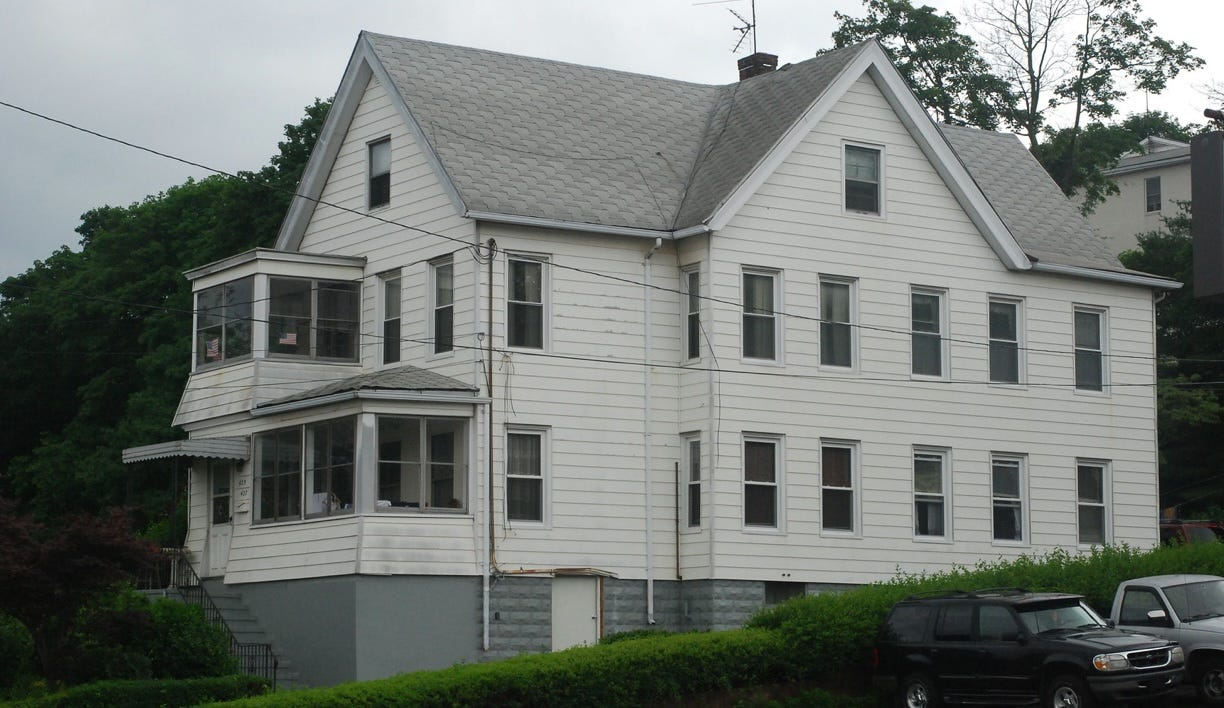
For most of my life, our family’s heart was one big white house in New Haven. My grandparents, Michael and Maria, my Nonnie and Poppy, bought it together with their son Alphonse, my Uncle Foe, and his wife, Eleanor, my Auntie El. Their kids were raised there, and everyone who came after—grandkids, great-grandkids, nieces and nephews—spent their childhoods in it. After Nonnie and Poppy died, their daughters, my aunts Mena and Madeline, stayed upstairs. After Uncle Foe died, Auntie El stayed downstairs.
Eighteen years ago, Auntie El died. She was Cynthia’s mother, making her the grandmother of Al, Cindy, and Denice, among many others. Whenever my sister and I traveled to New York on business, we’d take the train to New Haven and stay with her. She took such good care of us that we never wanted to leave. We used to joke that she had the bedroom wired, because we’d lie there late at night and whisper that we were hungry, and within minutes the kitchen light would flip on, and she’d be pulling out leftovers. After she was gone, the bottom floor sat there like a hole the size of a city, and all the family could do was rent it out to strangers. I felt that hole every time I walked into the stairwell. But the upstairs was still intact, until it wasn’t.
Three years later, Aunt Madeline died. My sister and I wrote her eulogy, and I flew back to deliver it in the church. After that, Aunt Mena was up there alone.
Seven years after that, Aunt Mena died, the last of my father’s siblings. Once again my sister and I wrote a eulogy, and once again I flew back to give it, but this time everything appeared different. The house was already empty.
Aunt Mena had been living alone when she fell, and after that she was moved into assisted living. Al and his daughters had wanted to move in and care for her. Several of us, Al included, wanted to buy the house to keep that piece of our childhood intact. It didn’t happen that way. Family members made difficult decisions for her safety, and soon after, they sold the house. Maybe it was too painful to keep.
I flew into a New Haven I hardly recognized. I couldn’t bring myself to drive past the house. It felt like somebody had taken a piece of our childhood and knocked it down along with the walls. Losing the house was one kind of grief. Burying the people who filled it was another.
Al and I have never really gotten over it. When we see each other, we slip off somewhere to blow off steam. He’s the only person I’ve ever met who can one-up me on the use of the word fuck.
Things change, and life moves on, but this small group of us wants to stop time. We want to see the family, talk about the old days, and never forget what we had. We want get togethers with sauce and meatballs on the stove. We want our childhood back, and we’re the ones still trying to hold on to pieces of it.
Our nonnie, the aunts, the uncles, our own parents—all of them would have wanted us to keep this going. I liked that we never really had a choice; you weren’t asked to show up. It was expected, and everybody was happy to meet that expectation. I know they would never have let it fall apart while they were in charge.
It really was the best of times.
My cousin Mike said it better than I ever could: “Every Sunday was Christmas for us as kids.” That’s exactly what it was, and exactly what we lost.
I try to be honest with myself about why it isn’t like that now. People didn’t stop caring. It was a different time, before the internet, before everybody’s attention lived on a screen, when Sunday dinner didn’t compete for a teenager’s time. Ask most teenagers or young adults today if they’d rather spend an afternoon at a relative’s house making small talk with people twice their age, and they’ll tell you they’d rather be anywhere else. Getting twenty or thirty people to the same table, coordinating that many lives, was easy back then. It’s much harder now. So this isn’t a story about people who failed to show up. It’s a story about the handful who still do.
I know I’m not the only one who misses this. Plenty of families still live stacked on top of each other: a grandparent in the back bedroom, a married daughter and her kids upstairs, an uncle who never technically moved out. Italian families used to run that way as a matter of course, and some families still do. If you grew up in a house like that, or still live in one, you know what I mean when I say it was never a burden.
Which brings me to a conversation I had with my grandson Riley. He’s twenty-one now. He’s been to England, lived in Portland, Oregon, for a while, and toured across several states, but he talks to me most about New Haven. He was there a year ago with his former band, and he returned in July with my husband, me, his cousin Eliot, and their friend Chester. The boys had met Al when they were little, but back then he was just the big cousin who played with them the way he plays with every kid.
Eliot told me that Al hugged him so hard his feet left the ground, then said, “You’re family now.” That was all it took. One meeting as an adult, and Eliot was a fan for life. Riley got there first. He loves Al, and he’s bonded with Molly and Stella the way I bonded with my own cousins growing up. He and Eliot are like brothers, but Eliot lives a two-hour plane ride away. In a perfect world, there would be a version of New Haven for all of us, and Al would be the mayor.
Riley and I talked about my expectations, how much I miss the big family Sundays, the sauce and meatballs simmering on the stove, and he told me I might need to lower them. He’s not wrong, but then I asked him something he understood better than I expected. I asked why he loves New Haven so much, why he loves the mob stories and the family stories, why he loves Al and Stella and Molly, and Joe, and Johnny Cake.
Then I told him the truth. What he loves about these people is what he might love about me. These are my people, the ones who show up, the ones who refuse to let this particular corner of the family come apart, the ones still carrying what our parents and grandparents built, even now, even when almost nobody else is.
I love my family, and so do the ones I’ve written about here, and none of us plan on stopping. We’ll push for that reunion. We’ll call our cousins every time we’re in town. Some will be happy to hear from us, and some will be too busy, and we’ve made our peace with that. But we still carry what’s left of it between us: the recipes nobody wrote down, the jokes nobody has to explain, the understanding that when someone says, “Come over,” you go. I know our parents are up there watching us all, and I know they’re keeping score.
I also know that if my dad and his brothers were still here with us, somebody would be getting whacked.
A final note: I wrote all of this while Al was still here, and I’ve left it that way. I’m heading home to New Haven now for his funeral.
Here’s how I picture it. My father and his brothers are already at the table, in their good suits, and they’ve been holding a chair for him. His grandfather Foe had a quiet word with whoever works the gate, so nobody asked Al any questions on the way in. He gave every one of them that gigantic hug of his, the one that lifts you right off the ground, rolled up his sleeves, and went straight to the stove. Now there’s a pot of sauce going, and the uncles are bent over the racing form. Aunt Madeline is hollering at him for putting in too much salt, Aunt Mena is hollering at Aunt Madeline for saying anything at all, and Nonnie and Auntie El are ready to hit them both over the head with a wooden spoon. My father stands next to him with a piece of bread, tastes it, and says nothing, because there’s nothing to fix. My mom is tap dancing.
Heaven’s been run a certain way for a long time. I give it a week before it’s under new management.
Rest easy, Al. You’re with the family now.
Crying crying, so beautiful. xo