


There was a version of Joanne who existed before all of this, before the caregiving, the quiet rooms, the slow, patient tending to someone else's decline. That woman printed photographs of men she'd met online and pinned them to her office wall. She flew to Alaska once, to spend a week on a boat with a man she'd never met. She cancelled a 250-guest wedding just weeks before the event. She was, by every account, including her own, too much. Too loud, too opinionated, too scary. She still is, in flashes, when a story calls for it. But mostly now she is something else: patient in a way she never used to be, present in a way life eventually demands of anyone who loves hard enough. Devotion did that. So did time. And, finally, some hard-won wisdom.
She dreams of a future that combines her wild passion and her newfound peace, but for now, all of that other life waits. Her own story sits on a shelf, dusted off mostly in daydreams, while she tends to her mother’s instead.
Joanne is turning seventy this year, and she does not look it. She has shoulder length dark hair now, not the long, center-parted mane she wore in high school and through her twenties, when strangers used to stop her just to say she looked like Cher. That comparison belongs to a younger version of her, the one caught in old photographs. What she has now are dark eyes that miss nothing and a beautiful smile, one that can flip mid-story about her wild days into something almost sinister, like she is deciding how much of the truth you can handle.
She is still, unmistakably, a good-looking woman, and she carries a raunchy sense of humor that can reduce her best friend of more than fifty years to tears, the kind of laugh that makes you cross your legs. She calls herself a strega, the Italian word for witch, and it fits her better than any resemblance to a pop star ever did.
She is Italian in every way that matters. Her blood tells a longer story, one that starts in a town in the Campania region near Salerno called Giffoni Valle Piana. Her family came to the United States through Ellis Island into the Bronx, and finally out to Burbank, California, chasing a rumor her grandfather had heard about a good life out west. Her mother had five siblings, three older sisters, one younger, and an older brother who later became a public defender.
Her father was Cherokee, Irish, and Scottish, a Korean War veteran, and the son of a closeted KKK member. After his father died, he found the hood and burned it. That is her father's story in miniature: the old hatreds knocking at the door, and someone deciding to set them on fire instead of wearing them.
Joanne remembers her grandfather differently than his history might imply. She said he was gentle, the kind of man who would put her on his lap under a big tree and read book after book to her. It instilled in her a love of reading.
Joanne grew up in a family surrounded by cousins and aunts and uncles, a house that was always loud, always full, always Italian even when the last name on the mailbox said otherwise. That kind of house makes a certain kind of woman, one who loves loudly, fights loudly, and feels everything at full volume, and Joanne is that woman through and through. She is the oldest of three sisters. Mary is two and a half years younger, and then Teri, eight years younger than Joanne.
Growing up, the fights between the three of them are the stuff of family legend now, the kind of stories that get retold at every holiday table. Joanne once got into a fight with Mary and threw a ceramic mug that opened a gash in her forehead deep enough for stitches. Joanne was eighteen at the time and Mary was barely sixteen, which meant the hospital reported it as assault on a minor. A deputy showed up at Joanne’s work to look into it. Luckily, he had siblings of his own and let her off the hook. Another fight with Mary involved a tube of toothpaste squeezed into Joanne’s hair. Her parents were tired of the shenanigans and made her go to high school that way.
Physical altercations were simply a normal part of growing up. Their father hit them too, not beatings exactly, but what Joanne calls “reactive hitting.”
“He once chased me over a mile to a friend’s house to give me a punishment, but he never caught me,” Joanne says. “He could pull out a belt faster than anyone.”
It is the kind of childhood that either breaks a person or toughens them into someone who can survive almost anything. Joanne became the second kind. And being the oldest meant she went first into everything else too.
First into kindergarten, where she remembers being terrified and teased. First into junior high, where three girls she'd believed were her best friends in the last part of elementary school, right before they were all supposed to move on together, sat her down and told her, with ice-cold cruelty, that they were no longer her friends. She never learned why. She only learned that it hurt in a way that stayed. Interestingly, two of these girls invited her to lunch when they were all in their fifties, to apologize. Joanne still didn't get an answer, just the two of them blaming each other.
It got worse before it got better. A fight with two older girls she’d trusted, over nothing, ended with Joanne coming home with a black eye and a split lip, and her parents deciding, in the way of that generation, that this was simply the street teaching her a lesson she’d have to learn alone.
“This wasn’t New York,” she says now, half laughing at the memory. “This was fucking Burbank.”
But something in her calcified that night.
“I think it made me really work on being nicer to people,” she says, “because I know what it was like to not have people be nice to you.”
One of those random acts of kindness is a story her best friend still tells. This girl who had just turned sixteen, wearing hot pants, walked into a Burbank High School classroom fresh from Miami, having left every friend she’d ever had behind. Joanne was the first person to talk to her. Like Joanne, her new friend came from an Italian family, and the two have been inseparable ever since. It is one of the very few times Joanne let herself trust a woman completely, and that trust has never wavered.
The funny thing is, that same friend was jumped by two girls in her first two weeks at the new school, putting her in the hospital with a concussion. Joanne, who had known her only a couple of weeks, sat with her at the hospital the whole time. She never once mentioned that something almost identical had happened to her just a year before.
“Maybe it was too soon,” she says. “Or maybe it’s just a case of moving on. I don’t like to go back to the bad times.”
That may be true, but Joanne admits it’s also self defense, a way of not revisiting the moments that changed her. Her junior high betrayal, she says, set the groundwork for not trusting women, a caution that would follow her for the next fifty years, surfacing even in friendships she wanted badly to believe in.
“It always surprises the hell out of me when I believe somebody, and then it turns out that they were lying to begin with,” she says. “And in the back of my mind I know they were lying, and I just keep saying to myself, ‘No, Joanne, they wouldn’t lie to you.’”
Her parents’ marriage was its own education. Her father strayed, and her mother stayed, the way a lot of women of that era stayed, not out of ignorance but out of some inherited belief that leaving wasn’t an option available to her.
Joanne understood divorce. Plenty of her friends’ parents had done it. What she couldn’t understand was why her own mother didn’t. When she finally stepped back and looked at it clearly, she saw a woman who had been told by her own sisters, in no uncertain terms, that you stay with the man. No further discussion. As for her father’s restlessness, Joanne says there’s always a why.
“I think it’s because of where my father came from. He was an independent man who ran his family’s household by himself, and then he becomes the grand master of his own family and becomes smothered.”
Joanne likes to say she turned out more like her father than her mother.
“I’m more like him—impatient, impulsive, capable of a certain hardness and tenderness,” she says. “He taught himself patience late in life.”
If you want to understand the shape of Joanne’s twenties and thirties, understand that she was, by her own description, easily swayed by men, and not without reason.
“I had the look,” she says. “I had money because I worked. I didn’t have the education, but I was independent.”
She was engaged in her early twenties and called it off weeks from a wedding with two hundred and fifty guests, walking away from the enormous machine of it because something in her refused to marry a man who didn't understand her commitment to family, and who, when it counted, wouldn't go to bat for her.
Then came Barry.
“He was so good looking,” she says. “I was gaga in love with him.”
They married six months to the day after they met and stayed married twenty years, though they only lived together for ten of them, which tells you something about the particular dynamic of that love. They had two sons together, Evan and James, and Joanne adopted a third, Preston, her husband’s boy from before, whose mother was fighting a brain tumor and eventually signed away her parental rights so Joanne could raise him properly. Joanne had been mothering him since he was three years old.
By the time Preston’s mother recovered, she had remarried, and Preston was over eighteen and in the Navy.
Before Evan, there was a daughter Joanne lost in her fifth month of pregnancy, a loss she still carries the way you carry anything that never got the chance to become a memory of its own.
The marriage to Barry cracked slowly and then all at once, undone by money, which, according to Joanne, “seems to be the standard in my fucking life with men.” And then there was the kind of fighting that left neither of them anywhere to stand. They tried therapy, but it didn’t take. She remembers the fights now as things that should never have been tolerated by either of them.
“I really was very much in love with Barry until that marriage became so fractured and broken,” she says.
Her son Evan, now thirty nine, had a front row seat to it all. James was too young to remember.
“Unfortunately, Evan has a photographic memory,” she says. “He should never have had to witness this.”
What remains, decades later, is something rarer than most divorces produce: a friendship. She talks to Barry nearly every day.
Joanne sees now how much of that fighting in her marriage with Barry was simply a replication of what she grew up with.
“I can remember my mother throwing a glass of milk at my father at the dinner table, but he didn’t fight back,” she says. “I think my father was afraid of my mother’s family. Very much like The Godfather.”
Somewhere in the middle of all this, Joanne built an entire career out of nothing but instinct and nerve. She rose to senior vice president in the aviation industry, a woman who could tell you what a plane could land on and what it couldn’t, the design limits of the plane, and everything you need to know about cabin safety. She counted Steve Jobs and the Clintons among her many high-profile clients, and was once on call around the clock for Arnold Schwarzenegger’s household.
“I think it was miraculous how far I went up the corporate ladder,” she says.
She is proudest, though, not of the title but of the people she pulled up with her, like the single mother working at an AT&T sales desk who Joanne spotted and mentored into a real career in aviation.
She was also, in those years, a single mother in Los Angeles doing what she now describes without flinching as some very wild things.
“I did very daring things in my forties and early fifties,” she says. “Very promiscuous things. I was on the quest for a boyfriend.”
Tuesday nights were date nights. She printed photographs of the men she met on early online dating sites and pinned them to the tufted walls of her office like a woman building a murder board. She says she mainly did this to entertain her young staff who were always interested in anything that had to do with dating. She also saw this as a safety net. The staff knew who she was with and where she was going.
“Of course, the morning after a date, the staff wanted to know all the gory details.
There was the man in Alaska, who she says resembled Grizzly Adams, a federal forestry agent who wrote and produced a documentary on brown bears for National Geographic.
“I was too citified for him,” she says.
There was the judge who handled mental illness cases and brought his golden retriever on every date with Joanne, which is ironic, given his line of work, since bringing a dog along felt a little unhinged. He'd had several dogs over the years, and always gave them the same name: Mattie.
There was the one with the gorgeous online profile who turned out to be living out of a van at a campground rather than the mansion he’d described, a man Joanne’s son Evan nicknamed Johnny Red Corn on sight.
And there was the one she obsessed over for a while, tall, older, funny, in the entertainment industry, with real kindness buried underneath. She even lived in his back house for a stretch. They were never quite compatible but remained friends.
These days, she's given some real thought to why she picked the men she did.
“Sex in my house growing up was a taboo subject,” she says. “It was never explained to me that a rational adult in a real and committed relationship means love and monogamy. For me, sex was just about getting off; giving your body to someone.”
She thinks she picked up a more male perspective of sex from watching her father navigate his marriage, and the woman who stood by and watched.
“I carried that through my entire adulthood,” she said.
That perspective found its clearest expression in an affair, one that has resulted in a different kind of reflection than the rest. He was married, older, and showered her with expensive hotel rooms and dinners. At the time, she thought it was love. Looking back now, she says it gave her something different, something more like a high.
“At no point in time did I ever think he would leave his wife,” she says. “And he never did.”
She wasn’t waiting for that ending. She understood, even then, what she was choosing. What she contemplates now isn't the affair itself so much as the arithmetic of it, a man's whole deception, the wife, children, and grandchildren he'd built a life around.
“I looked at that man more so than the wrongdoing on my part, and think, ‘How could you? How could you live like this?’”
It is a way of reasoning she’s honest enough to name for what it was: a cop-out, telling herself the sin belonged to him because he was the married one, and she wasn’t.
“It’s a cowardly cop-out,” she says now. “You can only live like that for so long before something horrible happens, or something wonderful happens.”
For Joanne, it turned out to be the second thing. Stuart, a former screenwriter, producer, and director, walked into her life, and the affair ended the way most borrowed things eventually do: for good. What drew her to Stuart was simple.
“He was tall, funny, kind, smart, and Jewish, and he could always make me laugh,” she said. He came into the marriage with two grown sons, Miles and Max, both of whom Joanne has grown close to.
They have been married sixteen years now. He is the one, out of everyone, who understood her most completely and loved what he found there without trying to change her. He came from a world so different from her loud, squabbling Italian family that it took him years to understand it, and longer still to love it. He studied at USC School of Cinema, and Occidental, worked alongside icons like Fellini, Lily Tomlin, Christopher Guest, and Tim Conway, wrote the 1987 hit comedy film Summer School, and was nominated for several film and television awards before turning his life toward helping people fight their way out of addiction.
Stuart’s own recovery decades ago set the foundation for that second career. He was on the cutting edge of therapies for heroin addiction, and his former clients will tell you the thing that stood out most about him was never just the expertise, but the compassion.
Joanne watched him build something out of other people’s worst days for years. But the rehab industry has changed, grown corporate in a way that pushed a certain kind of person out of the profession, and that shift is ultimately what drove him to leave it behind. He is a little broken now, the kind of breakage that comes from losing the very thing that gave your work its meaning, and Joanne knows it, even as her attention is pulled elsewhere by the person who needs her most.
Her mother is ninety two, deep in the fog of dementia, her hearing nearly gone. To care for her properly, Joanne rented out the beautiful home she and Stuart own, and moved in with her mother, trading her own independence for a smaller, quieter world with a very small footprint. It is the kind of sacrifice many Italian daughters know intimately, the assumption nobody ever has to say out loud, that you do not put your mother in a home. And being the oldest daughter brings the greater share of the responsibility with it. Her sisters each come by once a week to help, but Joanne is the one there around the clock, feeding her, bathing her, dressing her.
“It’s like taking care of a toddler all over again,” Joanne says. “My mother is incapable of making executive type decisions, so she resorts to being a child and not communicating her feelings.”
Joanne is, by her own word, housebound most days unless she can arrange care long enough to leave. The mother she knew is mostly gone.
“Ditch the ego and the anger,” Joanne tells herself, “and be compassionate to someone who is really not my mom anymore. She’s not the person that raised me and loved me.”
What she misses is specific: “I miss her laughter and her jokes, and her camaraderie. Let’s go shopping. Let’s surprise so and so. Let’s gossip. Let’s drink wine.”
What she values most these days is her relationship with her boys, one that has survived some genuinely rocky stretches and come out the other side.
“My relationship with my oldest son, Preston, is loving, though I don’t get the face time to hug him, to smell him,” she says.
Preston lives with his wife and children in the Pacific Northwest. Joanne wishes she could visit more often. Her other two sons live nearby.
“Evan and I have had our challenges throughout life, but he’s the one most like me, and the closest to me. He’s the most intuitive with me. James and I are lovingly respectful to each other. He’s the calm one.”
Then there are the grandchildren, four of them, who make her want to live forever. Two are Preston and Vanessa's daughters, both beautiful and smart. The other two are Evan and Ashleigh's: a three-year-old girl who greets her with a running list of pointed questions, like why her hair looks different today or whether what she's eating is healthy, the kind of unfiltered noticing only a small child gets away with, and a five-year-old grandson who loves her more quietly, plain and unguarded. “Nene, I love you,” he tells her, and something in Joanne softens completely at the name. The nickname came from her sister Teri, who, as a baby, called her Nene and it stayed.
Joanne and her sisters are close, and these days their only fights are over who bowled the highest score when they get together at the local bowling alley, one of the few outings their mother can still enjoy. Dementia has taken a lot from her, but not her spirit of rooting for the underdog.
This slower season has left room for digging, and Joanne has done a lot of that through therapy. It started after a violent fight with one of her kids pulled every bit of ugliness and rage and confusion in her straight to the surface.
“I never wanted it to happen again,” she says. “It was something out of an alien. I knew I needed help so I started therapy.”
Joanne’s therapist told her to look for the messages. It has become something close to a mantra.
“How the fuck am I here?” she asks herself. “Where’s this big message I’m supposed to find?”
She thinks she already knows part of the answer, watching her mother fade: “Do not end up like this. Do not be this person. Do everything possible, by every means, to fight it."
She watched her own father fight to the very end, holding his hand as he took his last breath at ninety two.
"He did not want to go," she says. "And that's the way I want to leave this earth — not wanting to leave it."
So now Joanne waits, and thinks, and reflects. She still wants the whole rest of it. A house by water somewhere with a garden, something entirely her own. To be madly and passionately in love again, and to do the things she loves—swim, hike, garden, and maybe, she says, even that stupid bungee jump exercise thing.
“I want to be known as that seventy year old that can and did,” she says.
After nearly seven decades on this earth, underneath all of it, is the girl who sat under a tree on her grandfather’s lap while he read to her, the one who fell in love with books before she fell in love with anything else. She still reads constantly, and she is always the first one to tell you about whatever she just finished. Her favorites are Charlotte’s Web and The Story of Edgar Sawtelle, and she laughs at the fact that both are stories about someone living on a farm surrounded by animals.
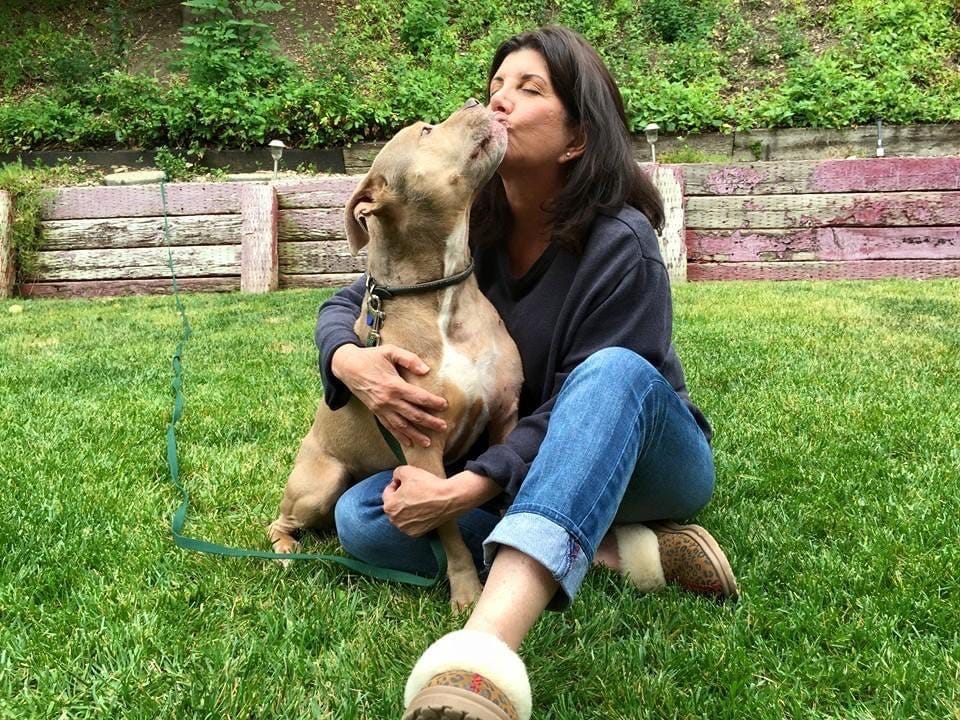
Joanne loves her pets the way some people love their own children. Her pit bull, Eddie, recently crossed the rainbow bridge, and she still talks about him like family.
“He was a human in a dog suit,” she says. “He was a son. He was my cohort in crime. My drinking buddy. The protector of my chickens. The protector of me.”
These days there is Kiwi, a cockatiel who imprinted on her the moment he tumbled out of a box of six siblings and has been devoted ever since.
“He can hear me drive up in the driveway,” she says.
And there is Charlie, her most recent rescue, a mixed terrier who leapt into her arms the first time they met and has not left her side since.
“There’s some underlying message I give out to these animals,” she says. “It’s a cherished gift. I’m a steward of their lives.”
That description fits Joanne perfectly, well beyond the animals. She takes in everything that needs taking in, stray chickens, stray dogs, and more than a few stray people. She has lost count of how many of her sons’ friends have landed on her couch when they needed somewhere to go. Her best friend still tells the story of the time she was going through a divorce and Joanne handed her a set of keys to her house and, as she puts it, carte blanche to all the salami and wine inside.
“I guess I just like helping people,” Joanne says. “I like having people around the house.”
As for that girl under the tree, she never really left. And neither did the wild one who came after her.
“Before the kids, I was just a big kid,” she says, and something in her still is, somewhere underneath the caregiving and the worry and the small rooms she now moves through. You can hear it when she talks about her son Evan’s fearlessness on a skateboard when he was younger, because she recognizes it. It was hers first. James, her younger son, gave her something different.
“I’ve learned through James mostly, about boundaries and respecting people’s decisions that I don’t necessarily align with,” she says.
He is the gentler side of her, the one she is still learning from. As for what her kids think of Joanne's decades of learning and growth, she has her own take.
“I think my kids would describe me as a never-ending adventure,” she says.
Recently, her son Evan told her that their life was confusing, their house was confusing, but that she did her best. She was holding down everything, providing for her children, all while working an incredibly stressful job.
“I must have done something right because my kids are amazing young men with amazing families and in relationships that are healthy and sound,” she says. “They’re not afraid to dig in and get shit done, and they’re always there when I need them.”
One lesson she keeps returning to is: “Be careful how you live your life, because sometimes things that you think are just for you really aren’t. They have a domino effect. And the things that you think bring you joy can sometimes be devastatingly hurtful to someone else.”
So she keeps moving, one more chapter, maybe two or three, badass enough to still believe it’s coming, looking for the message hiding inside whatever comes next.
Wowwwwwwwwwwww so much strength here!!!!!