Elena Jarvis once stayed up all night with Kris Kristofferson, the country legend who wrote “Me and Bobby McGee” and starred in the 1976 film A Star Is Born with Barbra Streisand, which Lady Gaga and Bradley Cooper remade in 2018. With the tape recorder running, he talked about Janis Joplin and played songs until the sun came up. She sat in David Letterman’s beat-up truck, the one Johnny Carson wanted off his street, while he talked for an hour without once looking her in the eye.
If they were a major music act in the ’70s and ’80s, Elena probably interviewed them. She even interviewed Madonna, then taped over it because the future Material Girl got on her nerves.
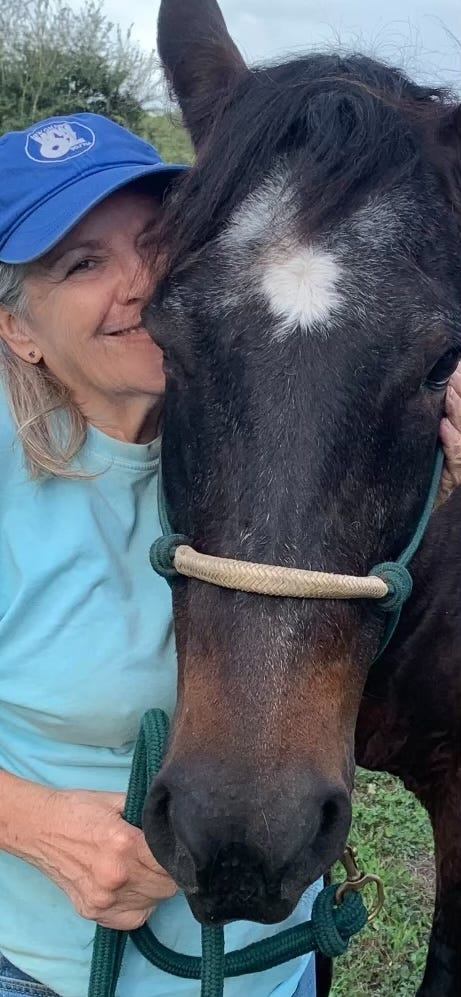
These days, her mornings belong to Lucy, her 28-year-old horse; two 7-year-old dogs, Shaka, a blue heeler, and Honey Bunny, a husky-wolf mix; and whatever wanders over from the wildlife refuge next to her three acres in East Central Florida.
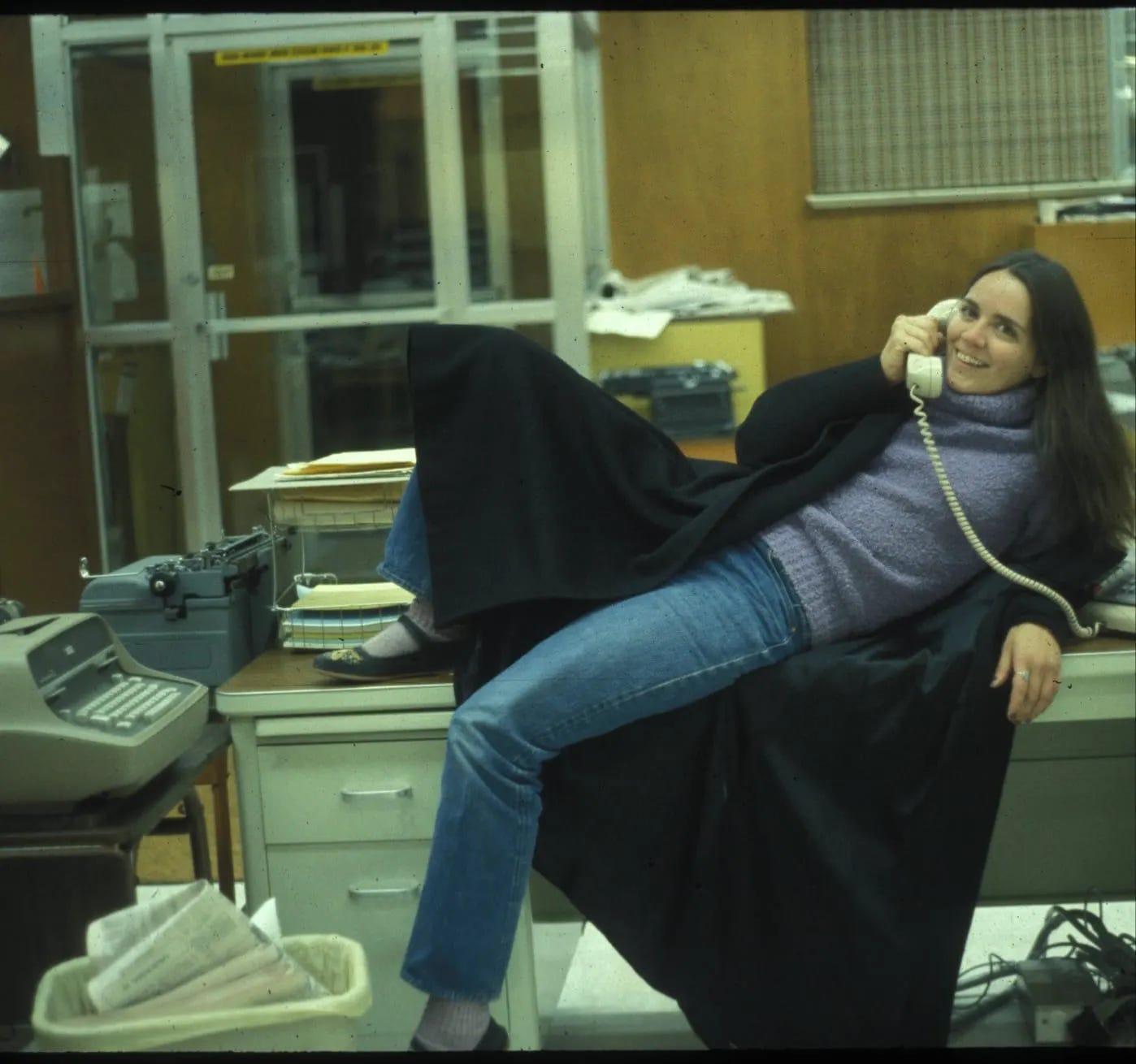
Getting there took decades. She was an entertainment reporter and editor who built entertainment sections from scratch at three newspapers, back when nobody considered music a real beat, and freelanced for a slew of magazines.
She went on to spend decades teaching journalism and advising student media, and by her count she taught well over 12,000 students.
Now, about to turn 74, she is a writer with more material than time, and a lifetime of tapes, letters and records looking for a home.
“I mark my life by different songs,” she says. “I’m one of those annoying people who talk in lyrics.”
It all started with a lot of moving. Her father was a career military officer, and the family never stayed put for long. Elena was born in the Bay Area, then lived in California, Arizona, Nevada, Texas, and Florida, back and forth, with all her siblings born in Florida along the way. Then the family moved to Panama.
“I grew up in Panama, in Central America, and then moved back to Texas, and then my dad retired in Florida,” she says.
All that moving made for a lonely kid. She didn’t have many friends, so she read.
“I thought, wow, if you can read this book and it can transport you into a better world and make life more bearable, that would be a very noble thing to do as a living.”
Then she read writers’ biographies and rethought the plan.
“I said, I don’t want to suffer and live in a garret and starve to death while I’m waiting to be discovered.”
The answer came from the funny pages. Brenda Starr, the glamorous comic strip reporter, made journalism look like an adventure.
“She was so glamorous, and I thought, well, there you go,” she says. “I’ll become a journalist.”
The music came from her father.
“My father was an alcoholic, but he was a very big music fan,” she says. “All different kinds of music, from Harry Belafonte to Sinatra. He loved Steely Dan.”
That rubbed off.
“I’m not a music snob,” she says. “All forms of music have something to commend them.”
Her sense of social justice came from her grandfather, a Methodist minister. Put the two together, and you get a girl who believed music was the most powerful way to reach people, and who started writing for newspapers at 13.
When the family returned to Florida, she joined the high school paper. Her advisor was Florence Graves, who Elena said went on to break the Bob Packwood sexual harassment story and to start the investigative reporting program at Brandeis University.
“Just a phenomenal person,” Elena says. “She was my mentor.”
At 14, Elena won first place in the state of Florida for opinion writing. The plan was to become a heavy-duty investigative writer. She was good enough to get into Northwestern’s Medill School of Journalism, one of the country’s most prestigious journalism programs. She couldn’t afford it.
“I didn’t have the money to go out of state, so I went to a college in Pensacola.”
She brings it up more than once, not with bitterness exactly, more like someone who has spent 50 years thinking about the road not taken.
“If I had gone to Medill, I never would have become a rock and roll reporter,” she says.
Instead, she went to the University of West Florida and became an editor, which meant doing every job nobody else wanted. Big names were coming through campus, and one of them was B.B. King.
“I’m trying to make the assignment, and nobody wanted to interview B.B. King,” she says. “I said, well, what the fuck? I’ll interview B.B. King.”
After that, she interviewed everyone who came through town: Jimmy Buffett, Albert King, Freddie King. And Kris Kristofferson.
“I spent the night with Kris Kristofferson,” she says, and then, before anyone gets any ideas: “Not in that sexual way. I stayed up all night interviewing him. I still have it. I digitized it. It’s four hours long.”
Those campus interviews got her foot in the door. An older classmate, back in school to finish his degree, helped her land a job at the Pensacola News Journal, a Gannett paper. Her title was music reporter. Her actual job was music reporter, obituary writer, weather writer, consumer action line, copy girl, and gofer. The paper wanted young readers, the way papers always do, and figured Elena could bring them in. So she helped build its entertainment section from scratch.
In 1974, entertainment wasn’t considered a legitimate beat. Elena was one of four women in the newsroom. The other three were society writers. Her column went into syndication through Gannett, but it did not translate into income.
She also freelanced for several music magazines, including Goldmine and Rolling Stone, where she wrote for the “Random Notes” column.
“Did I make more than my $65 a week? No,” she says. “But I got to go to all the concerts. That was the payback.”
She adds, “There were no medical benefits, no pension, and one week of vacation after ten years. Overtime? Are you kidding me?”
The concerts were worth it. She covered everything from New Orleans to Panama City. Southern rock was king, and she spent plenty of time with Lynyrd Skynyrd, not her favorite, and the Allman Brothers, whom she loved. But she also went where the real blues was. This was the Jim Crow South, and the great Black artists played the Chitlin’ Circuit, not mixed clubs.
“If you wanted to see true blues, you had to go where it was,” she says. “I would go to the Black side of town, where I was the only white face in the whole club, and see people like Bobby “Blue” Bland and Aretha Franklin.”
She describes Abe’s 506 Club, a segregated nightclub in Pensacola’s historic Belmont-Devillers neighborhood, as if she were there last night.
“Top-of-the-line musicians, everybody dressed to the nines, a cigarette girl in a little leopard pillbox hat, working the room,” she remembers. “They were so classy.”
Being a woman on that beat came with its own baggage, some she still carries.
“Even today, when people find out what I did for a living, they say, ‘Oh, you were a groupie,’” she says. “They would never say something like that to Cameron Crowe.”
She shakes her head. “Not that there’s anything wrong with being a groupie. They support the arts in their own way. But that was not my way.”
That reputation opened doors. She was the only woman allowed backstage at the Mobile Municipal Auditorium the night she interviewed Ann and Nancy Wilson of Heart. The sisters were dating their guitar players at the time, and right in front of them, the boyfriends started hitting on her.
“They’re saying, ‘Oh wow, you’re the best-looking woman reporter I’ve ever seen,’” she says. “Right in front of those girls. I was so disgusted, and told them so.”
She and the Wilson sisters became pretty good friends after that.
“Even the women in rock and roll didn’t get any respect,” she says. “And I’m not sure it’s all that much different today.”
Off the clock, she was just as fearless. She did a lot of crazy stuff, and she doesn’t regret any of it. At her first job in Pensacola, she overheard the older reporters clucking about how terrible LSD was.
“I said, well, I’ve done it 1,000 times, and look, I’m okay.”
The craziest story goes back to 1976. She and two other reporters went to Mexico to interview Americans locked up on drug charges, and she ended up stranded in Nogales, Arizona, with no money and about 100 miles to go to get to a friend’s place in Bisbee. A guy at a gas station offered her a ride after his shift, and she waited at his mother’s house until he got off work. As they were leaving, his mother mentioned he hadn’t been doing that great since he got out of the mental institution. Halfway across the empty desert, Elena noticed him fingering a huge lug wrench wrapped in silver duct tape. Then he pointed to a Penthouse Magazine on the floorboard and asked her to read him the sex letters.
So she talked. And talked. Somewhere along the way, she figured out he knew her friend in Bisbee, and she made sure to mention that her friend was expecting them both. When they pulled into town, the friend took one look at the driver and told her to get that lunatic out of there.
“If I hadn’t been such a blabbermouth,” she says, “my bones would still be moldering somewhere out there in the desert.”
She doesn’t regret that one either.
“It’s all material,” she says.
Material didn’t pay the rent, though. After six or seven years in Pensacola, she couldn’t get a raise or a promotion, so she left for Colorado Springs and built another entertainment section from nothing, this time as entertainment editor at The Gazette. Jazz ruled there, and the city had a big classical scene, so she leaned on people who knew more than she did.
“I’m not an expert on music,” she says. “I always thought you had to be a musician to be a true expert.”
She knew how to do her homework, and she preached it to her students for years.
“Read the books. Know the history. You won’t get it all from Googling.”
Colorado went the way of Pensacola.
“I couldn’t get a raise, couldn’t get a promotion, couldn’t get nothing,” she says.
So in 1984 she moved to Ventura, California, to join the Ventura County Star, the daily newspaper for all of Ventura County, acquired by Gannett Co. Inc. in 2016.
“I was ostensibly sent to cover the Olympics,” she says. “I was covering the kayak racing in Lake Casitas.”
The VC Star became home for years. She wrote about 35 feature stories a month on music and the arts, plus social justice stories she cared about, and she made her own assignments. She says that freedom was the real gift of missing out on Medill.
“If you go to work for the LA Times and you’re writing about music, that’s all you’re writing about,” she says. “I was able to write about whatever I felt like writing, which was a blast. Was it profitable? No. But it was a lot of fun.”
All that writing left her with a mountain of tape, somewhere around 2,000 interviews on cassette. Some still stand out. The Kristofferson tape, of course. Emerson, Lake and Palmer, who played her songs during the interview. And the obscure ones she loves most, with blues players nobody remembers, like Willie "Ooh Wee It's a Miracle" Hightower.
Then there’s the one that no longer exists.
“I had a good interview with Madonna,” she says, “but she pissed me off, so I taped over it.”
It was a phone interview around 1983 or 1984, when Madonna’s first record was coming out.
“She’s going on and on about how she’s gonna be a big star. Okay, fine, great.” Elena rolls her eyes, then concedes. “Hey, you can’t argue with success, can you?”
The Letterman interview, on the other hand, she earned the hard way. It was the ‘80s, and she was buried at her desk in Ventura when the owner of a little motor speedway in Oxnard called. He told her David Letterman loved racing miniature cars. He was coming that day, and he’d agreed to do an interview.
The rookie at the next desk told her to just wing it.
“I said there’s no way in hell I’m going to wing an interview with David Letterman. Have you ever seen him interview people?”
So she went to the library and spent two or three hours reading everything she could get her hands on. Then she drove to the track, and sure enough, there he was.
“I said, ‘Hi, I understand you said you would do an interview,’” she says. “He says, ‘I never said any such thing.’ I said, ‘Well, here I am.’” She grins. “And he said okay.”
They sat in his old pickup truck and talked for about an hour. That refusal to look at her, Elena thinks, came from the woman who had been stalking him at the time. In her experience, almost every comedian she interviewed turned out to be depressed and withdrawn in person. The exceptions were Bob Hope and John Cleese.
“John Cleese is funny, and he’s an upbeat personality,” she says. “But not David Letterman.”
Still, Letterman gave her a great story. He and Johnny Carson were neighbors in Malibu, back when everyone was waiting to see who would take over Carson’s chair.
“He tells me, Johnny’s really mad at me because of my old beat-up pickup truck,” Elena says. “He doesn’t like me parking it on PCH in front of my house because it’s bringing down the neighborhood.”
So Letterman went out, bought the most expensive car cover he could find, and threw it over the truck. Peace was restored.
“Every time I drove up PCH,” Elena says, “I knew exactly where David Letterman lived. And Johnny Carson too.”
For all the rock stars, the story she calls the most important of her career has nothing to do with music. She wrote it for Defenders of Wildlife Magazine, about the Barstow-to-Las Vegas motorcycle race, thousands of motorcycles revving across the Mojave Desert. To cover it, she got up at 2 a.m. and drove to Barstow through fog so thick she couldn’t see the hood of her car.
“I was so afraid I was going to die,” she says.
The story earned rave reviews from the LA Times and helped pass the California Desert Protection Act in 1994.
Somewhere in all of that, she also became a journalism professor. She started teaching at a community college in Ventura County, north of Los Angeles, while she was still at the VC Star, partly because she needed the money. But people in the newsroom kept griping about the new hires.
“They were saying, ‘What are they teaching them in college? Because they don’t know shit about decorum or discretion or reporting,’” she says. “I thought, ‘Well, maybe I can help. Give other people a leg up, because I’ve been through the same thing they’re going through.’”
Later she went all in. She earned her master’s while freelancing at the LA Times, and in the middle of it all, she was divorcing her husband of 14 years, a musician. She left the newsroom and took over UCLA’s media publications program. Part of the reason, she admits, was pure fantasy. She’d been writing 75 to 100 pages a week for a newspaper and wondered what she could do with a book.
“I thought, if I got into education, oh, I’ll have all this free time,” she says. “I’ll have all the summers. All I have to do is go in there and teach a class or two, and the rest of the time...” She throws up her hands. “Oh, fuck me, right?”
Teaching and advising student media turned out to be even more all-consuming than journalism, and then life made its own plans. When her mother developed dementia, Elena left UCLA and her house by the beach and moved to Florida to take care of her. It became a 17-year ordeal. She spent 20 years at Daytona State College, teaching five classes of 30 students a semester, plus extra classes to pay for her mother’s assisted living.
Through every move, the other half of the reason she stayed in the classroom was what kept her going. Elena went to community college and a state school, not an Ivy, and built a career anyway. She wanted her students to see that.
“Look what I was able to make out of my career,” she says. “If I can do it, you can do it. There’s nothing to hold you back.”
Some students, she says, heard that as bragging. Plenty of others heard permission, and they still talk about her that way. She calls it paying it forward.
“I owe the people who helped me,” she says. “You turn back and help the people behind you. Let’s face it, journalism is the only link to reality we’ve got. We need journalists with compassion and heart who know what it is to struggle.”
That conviction comes partly from what she saw at the top of the business. She freelanced for the LA Times for four years and met plenty of wonderful people there. She also met elitists. She remembers one hire at The Star who arrived with a Harvard divinity degree and a string of Ivy League credentials.
“She could not write her way out of a wet paper bag,” Elena says.
Elena says we need journalists who know the struggle.
“We need people in the media who know what it’s like not to be able to pay your rent if you put gas in your car. I didn’t even have a telephone in college. Whenever I wanted to call someone, I had to go to the 7-Eleven, use the pay phone, and have them call me back there. How we communicated is beyond me, but we did somehow.”
For all that, she hasn’t given up on the business. She believes journalism will emerge from this upheaval stronger and more necessary than ever, even as corporate owners chase shareholder profits, and she sees real openings on platforms like Substack for independent voices. In a world drowning in misinformation and AI slop, she says, credibility is everything.
“It’s like drinking water out of a fire hose,” she says. “The journalists who make it will be the ones who can distill that flood into what people need.”
Her advice to students who are dead set on the field anyway is blunt.
“It’s a war of attrition. It’s always been a war of attrition,” she says. “Just keep trying. Network. Be open to people.”
She says perseverance is the number one talent a journalist needs. When she got her first job in 1974, the country was in a recession, and everyone told her she’d never work in journalism.
“But I got a job in journalism,” she says. “And now there are more outlets than ever.”
Her own war of attrition ended somewhere much quieter. Today, the wild is right outside her door. She has cared about the land since she was a kid in Panama.
“You’re surrounded by all these natural wonders,” she says.
It makes sense, then, that she ended up where she is. Her three acres sit on the edge of a wildlife refuge.
“I see bears every day,” she says. “Every time I go out in my yard, I have a nature encounter. It might be a bird. It might be a raccoon. It might be a possum.”
The writing has been slower lately, but she is working her way back. She is 150 pages into a novella about a man named Jason, built around a painting the artist Henry Taylor made of him at Camarillo State Hospital, long before Taylor got a retrospective at the Whitney. Elena bought one of Taylor’s paintings for $250. Auction houses have told her it could go for $150,000. She’s not selling, at least not until she finishes the novella. She hopes to finish it by February or March.
There is also a biography of Michael Balog, the Ventura artist who took his own life with a rifle in the summer of 1987. The research is done, along with a 50-page proposal, chapter outlines, and sample chapters, waiting on an agent.
She writes every day, but says it’s sometimes more like journaling.
“I haven’t really written anything of substance for about a year,” she says. “It’s such a chaotic time in our world. There are bigger fish to fry.”
And then there’s the stuff, a lifetime of it.
“I spent my whole life, as writers do, collecting material in hopes of being able to write about it later on,” she says. “Well, now I find myself running out of road. I have much more material than I have time to write.”
The inventory reads like a museum catalog. Somewhere between 2,000 and 3,000 albums, CDs, and cassettes. Mix tapes. Bootlegs, including a Little Feat show from the Santa Monica Civic Auditorium. About 2,000 taped interviews. Personal letters from musicians and other celebrities. A file cabinet full of press kits and promo pictures. Books, sheet music and posters.
“I think that would be a fine addition to somebody’s collection,” she says.
She wants it to go to a university or a student radio station, someplace scholars and students can actually use it. UCLA has a fantastic music library, and she used to see Bob Dylan going in there, but they’re full. So she is writing letters to other music schools and waiting to see who bites.
“It’s a huge endeavor,” she says.
Meanwhile, she writes, looking out at the refuge where the bears wander. She used to say there was no point in writing if nobody read it. She’s changed her mind.
“If you get joy out of it, you like what you’ve written, then hey, mission accomplished,” she says.
At 73, she doesn’t waste much time worrying about getting older.
“I’m just fortunate that I am old,” she says. “I’ve done some crazy shit in my life.”