I remember the first time I heard Joni Mitchell. I was barely thirteen, living in Miami Beach, and hanging out at my friend’s house. She had a beautiful sister, a hippie chick wearing bell-bottom jeans, a ruffled shirt, and long brown hair that flowed down her back. One afternoon, her sister put on the album, Song to a Seagull, for us. She made it clear that Joni Mitchell was everything.
The song that got me was “Cactus Tree.”
There's a man who's been out sailing
In a decade full of dreams
And he takes her to a schooner
And he treats her like a queen
Bearing beads from California
With their amber stones and green
I loved Miami Beach. I loved the warm ocean, the sunshine, and my friends, and I never wanted to leave. But even there, we all dreamed about California, because so much of the music we loved came out of there. I read every music magazine I could get my hands on, and they were all about the Los Angeles scene, the Whisky a Go Go, and the Sunset Strip. I loved The Doors, Procol Harum, and of course the Beach Boys. Then I heard Joni, and my little life stood still.
I could say I became a fan, but that word has never come close to what she’s meant to me. Joni’s music became the soundtrack to every moment of my life.
Once you hear Joni, you have to share the magic. My friend’s sister did it for me, and I did it for my sister, Gina. She was born in 1964, so she was still a little girl when Joni came into my life, and she grew up on those songs right alongside me. I loved other artists on my own, but Joni was always something we shared. Gina is every bit as obsessed as I am, and our Joni stories are legendary.
A couple of years later, I needed Joni more than ever. I was fifteen, two months away from turning sixteen, and was told we would be moving again; like all the moves before, we left in the middle of the night. Dad was in trouble with the law again, this time while working for Sinatra.
Leaving all your friends behind is hard enough, but leaving as a teenager is more difficult. I didn’t want to go, but Mom kept telling me how wonderful life would be in California. Eventually, I got on board, and in our family, you learned to adjust to these moves. For me, I was halfway across the country when I started to see the light. Mom was right. I loved California.
But it was Joni who really got me excited with her song “California.” She wrote it while she was traveling in Europe, homesick and aching to get back. If Joni would even kiss a Sunset pig to get back there, it must have been pretty great.
Nothing prepared me for hearing Joni live. My first Joni concert was at the Universal Amphitheatre in Los Angeles in August 1974, when she toured with Tom Scott and the L.A. Express. I took, Gina, thirteen, with me. She played her acoustic songs and then these new, jazz-infused versions with a full band behind her, and I had never heard anything like it. Those shows became her first live album, Miles of Aisles.
California turned out to be where my real life started. It’s where I met my best friend of more than fifty years, met all kinds of rock musicians and saw epic concerts, and had my son at nineteen. I lived in Burbank, married to his father, whom I divorced six months after Andy was born. Hejira came out while I was pregnant. I used to sing “Furry Sings the Blues” to my belly, and my favorite part was when Joni drops into that gravelly, cranky old man voice for Furry, who points his bony finger at her and tells her he doesn’t like her. I did the voice right along with her, every single time.
Andy was the joy of my life, and for most of his first three years, it was just the two of us. I was a single mom, and my favorite days were our rides to the beach in my old pink VW bus with Joni on the tape deck. We sang her songs together, and every song from those years still reminds me of him. The two of us have an unbreakable Joni bond to this day. If anything new is happening with Joni, he messages me to make sure I know.
The next time I saw Joni was with at the Greek Theatre in September 1979 on the Shadows and Light tour. Gina was fifteen, the same age I was when we left Miami. Joni played electric guitar, backed by a jaw-dropping band of jazz musicians: Pat Metheny, Jaco Pastorius, Lyle Mays, Michael Brecker, and Don Alias. And somewhere in the middle of the set, she played “Furry Sings the Blues,” the same song I used to sing to my belly when I was pregnant with Andy.
My daughter, Summer, came along in 1982, five years after her brother, and she got her Joni start in the womb too. When she was little, my sister Gina made up a game where Summer had to learn all of Joni’s lyrics, and Gina quizzed that poor child over and over until she could recite every one by heart. She never failed the test. To this day, she’d still pass.
When I was single, I had one bottom line for anyone I dated: they had to love Joni Mitchell. No exceptions. Summer’s father was a rock musician and a total music snob. If it didn’t rock, he didn’t want to hear it. Joni was the one exception. He loved her, and said she was one of the best guitar players who ever lived. He passed the test. We were married for twenty-two years, until his drinking became too much and I had to walk away. To this day, “I Had a King” takes me right back to that breakup. It’s the first song on Song to a Seagull, the album where all of this started for me, and I never imagined it would one day be about me.
Gina and I both ended up in the music business in the 1980s, right in the middle of the glam rock days and all those hairspray bands. I ran a music PR and booking agency above the Whisky a Go Go, and my magazine was next door. I hired Gina to work there, and a couple of years later we launched our own magazine together. Rock stars surrounded us, but we would have traded unrestricted, 24/7 access to Mötley Crüe for one hour with Joni. Please, just let us meet Joni.
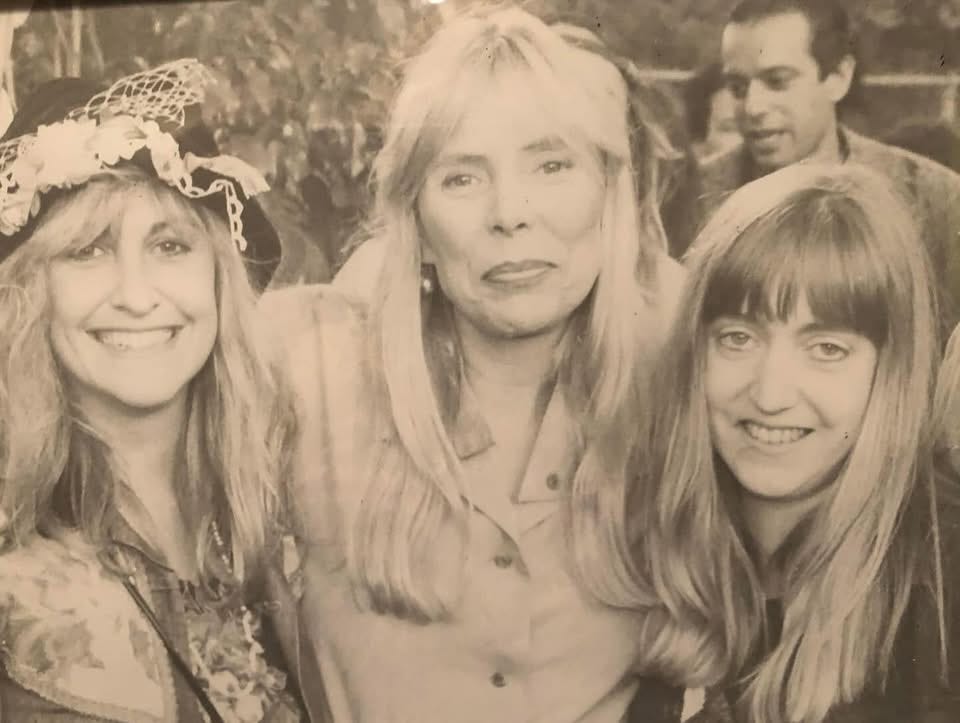
We first met her at the Troubadours of Folk Festival at UCLA in 1993, where we’d been given full access. We knew we had to compose ourselves. My sister fell to her knees at a fence nearby and cried because she didn’t know if she could take it. I kept telling myself to breathe. My biggest worry was what would happen when you finally met an idol. What if she was rude or standoffish? That wasn’t unusual in this business.
We never missed a Joni concert and had all the merch to prove it. We also used to shop at a Hollywood store called A Star Is Worn, which sold clothes that once belonged to stars, and Gina and I bought every piece that had belonged to Joni. At one show at the Greek, we sat in the first two rows wearing her clothes. The day we finally met her, I wore a denim jacket with a vintage pin of Joni’s face from a concert years earlier. She saw the pin and said, “Wow, that's an oldie.” Then we told her the story of buying her clothes and wearing them to her concert, right up front. She looked at the two of us and said, “I knew you two looked familiar.” She was lovely, so kind, so generous with her time, and so funny.
Some days you spend the rest of your life trying to describe. This was one of those days. We had no idea what to expect when we walked into FM 101.9 KSCA in Burbank for a Music Hall session. It was October 1994, and it turned out to be one of the greatest moments of our lives. There was no public access, just a handful of media people, and suddenly my sister and I were sitting a few feet away from Joni. The host, Merilee Kelly, said on the air that the studio felt “a little bit like a French cafe.” Joni wore a little chapeau, drank a cappuccino, smoked cigarettes, and played a six-song acoustic set with her guitars strewn around the room. I was sitting right next to the ashtray full of her cigarette butts, and I’ll admit, hoping I don’t sound like a nut, that I wanted to take a few home with me just because they were remnants of Joni. This was the same day that Turbulent Indigo came out.
Once we realized how intimate it was going to be, we had to keep up our professional behavior while all we wanted to do was cry. So we held ourselves together, and the minute we got back to the car, we screamed and cried at the top of our lungs. We got very good at this.
We were lucky back then. A friend of ours who worked at Geffen Records, Joni’s record label, and freelanced for our magazine gave us Joni access, and we will be forever indebted to him. (Funny side note: he became a high school teacher, and I became a college professor.) I mention it because once my sister and I left the music industry, the access went with it. We didn’t care. We were more than willing to pay a month’s mortgage to see Joni, and we never missed a show in Los Angeles.
Twenty-one years later, Gina and I were back at the Greek Theatre for opening night of the Both Sides Now tour in May 2000. Joni came out in a sweeping dress in front of a starry backdrop and a 70-piece orchestra, and she sang the whole album in order, all those old torch songs about falling in love and falling apart. Then she gave her own songs the orchestra treatment. Hejira, with Larry Klein on bass. “Both Sides Now,” older and wiser than the girl who wrote it. And she closed the night with “For the Roses.” We had no idea it would be the last time Joni headlined a show in Los Angeles for more than twenty years.
Three years after that show, my first marriage was over. I’d known Michael for years, but that’s when we finally started dating. He’s a doctor, not a musician, so I wasn’t sure how he’d do with my bottom line. Then, early on, he told me that back in medical school he owned exactly three records: Judy Collins, Judy Henske, and Joni Mitchell. He passed the test.
Every once in a while, access found its way back to us, and once it came through my Michael. He was on staff at UCLA, and as a surprise, he got Gina and me on the list for an evening at the Hammer Museum celebrating Joni’s 71st birthday in November 2014. Gina has a name for how that surprise turned out: Joni Behind Glass.
The event was a screening of The Fiddle and the Drum, the ballet film Jean Grand-Maître choreographed for the Alberta Ballet to her music, and Joni came out to the Hammer courtyard to answer audience questions and talk about her upcoming four-CD box set, Love Has Many Faces. We had no idea there was also a private party. We watched the ballet and the Q&A, and afterward we saw Joni behind glass windows being served cake and champagne. We stood there watching her for a while, wishing we were there, and finally went home.
When I walked in the door, my husband asked, “Did you and your sister go to Joni’s party?” I said, WTF DO YOU MEAN? It turns out we were on the list. He called the box office to double-check, then emailed me to say two passes were waiting for us. It was too long a drive to go back, and my sister was already on her way home. We still haven’t forgiven him. Every year on Joni’s birthday, my sister says, “Your husband,” and I yell at him all over again. I’d love to tell you his technology skills have improved, but they haven’t. How about a text? No, he figured I’d be checking my email at an event. I’m getting angry just writing this, but he redeemed himself, and I’ll get to that.
But none of that mattered that day in March 2015 when Andy reached out to tell me Joni had suffered an aneurysm. I fell apart. All I could think about was a world without Joni, and the image of her alone and unconscious. My first instinct was to run to her, but I had no way of doing that. It felt like a beloved member of the family was suffering. I prayed to the saints every day. Andy, Gina, and I checked everywhere we could for news. My husband was at UCLA at the time, but for ethical reasons he couldn’t check in on her, so we read every post, every story, every update.
Every scrap of news felt like a lifeline. When David Crosby said in an interview that she wasn’t speaking yet, my heart sank. Then her friend Leslie Morris posted on Joni’s website that she was speaking, and speaking well, and that a full recovery was expected. Judy Collins posted that Joni was making good progress. Graham Nash told an audience at the Grammy Museum that he’d seen her and that she would soon “be back to being Joni Mitchell.”
Later we learned how hard she fought. Just like when she had polio as a little girl and had to learn to walk all over again, she taught herself to play guitar again by watching videos of herself to see where she used to put her fingers.
I wanted so badly to see for myself that she was okay, and I never imagined I would. For my 65th birthday, all I wanted was dinner at Crustacean in Beverly Hills. I’d heard it was Joni’s favorite, and I wanted to go just because Joni had breathed there. My husband, still paying for Joni Behind Glass, took me. That night he finally redeemed himself, because as we walked up the sidewalk, there she was, sitting outside with her friend Leslie and two other women. I couldn’t speak. I stood there like a statue. She was there, and more than anything, she looked amazing. Healthy. My husband got us the table right behind her, and I told him we had to order everything on the menu if that’s what it took to stay in Joni’s world. I would never have disturbed her. I just sat in a state of Joni love.
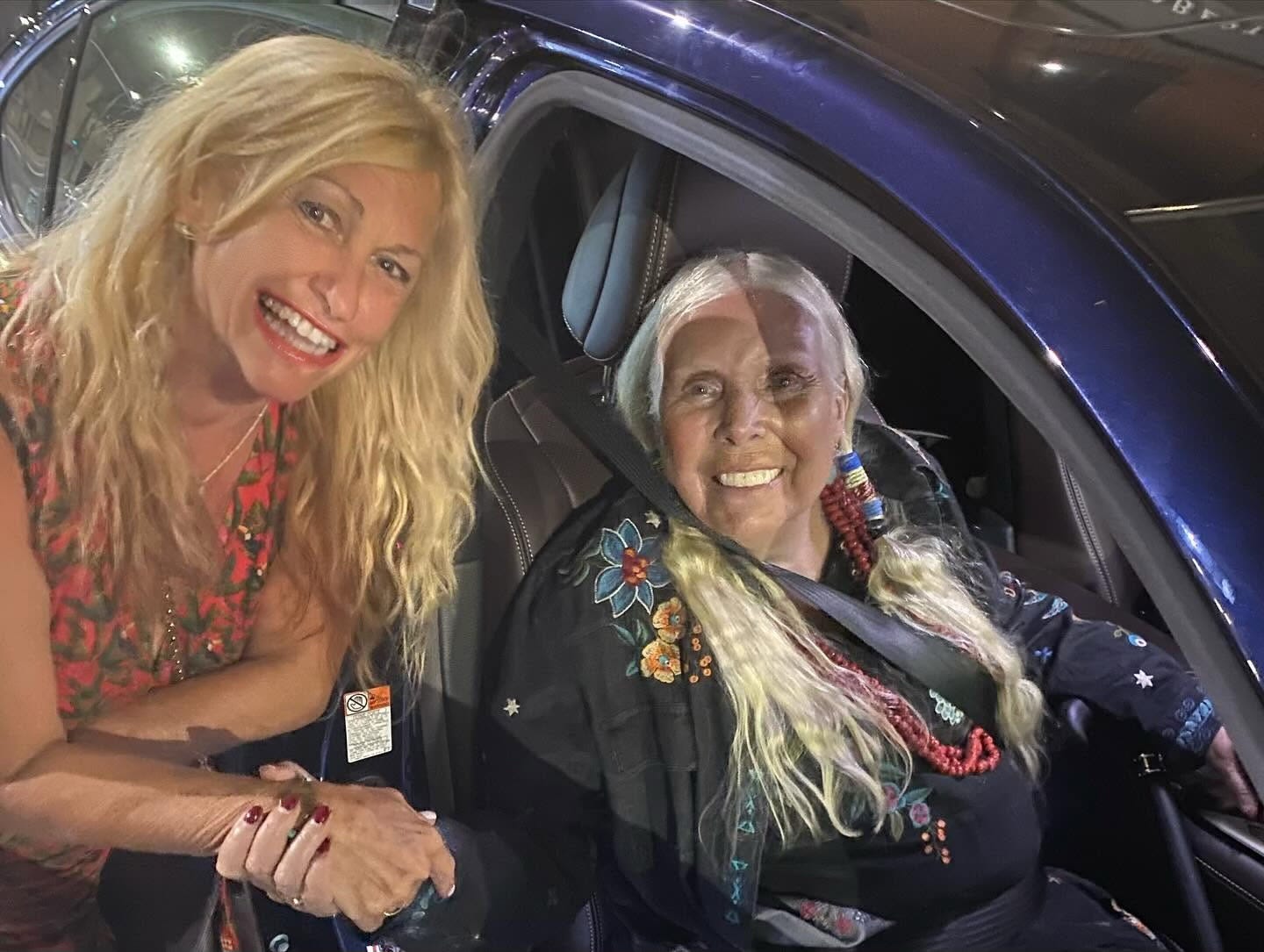
She paid her check, and so did we. A limo pulled up, and I stood on the sidewalk watching her walk to the car. Then my husband took off. He went up to her friend, Leslie, handed her his UCLA business card, and explained that he was a physician there, and that it was his wife’s birthday. He told her I had interviewed Joni years ago, and that I was such a fan that a hello would mean everything. Joni waved me over and told my husband he was a hero, that the UCLA doctors saved her life. Then she talked to me. She wished me a happy birthday, and I told her that seeing her healthy was my birthday gift. I mentioned that I’d had my own health struggles and had been diagnosed with heart disease, and that seeing her gave me hope. She held my hand and said, “We’re a couple of strong women. We’re not going anywhere.”
I may have to tattoo that on my arm one day. I’ve actually thought about getting a tattoo, but I told my very tattooed daughter, Summer, that I was scared I’d regret it. It’s permanent, and what if I changed my mind about what I’d put on my body in ink for life? She asked me what I would get. Joni lyrics, of course. She said, “Well, duh. Would you ever regret that?” Never.
After everything she had been through, Gina and I never stopped hoping we’d hear Joni sing live again. When we heard she was going to perform at the Newport Folk Festival in July 2022, we were beside ourselves. We wanted so badly to be there, but we couldn’t figure out a way to make it work. So we watched, and when Joni walked out with Brandi Carlile and returned to the stage, I felt so much relief, happiness, and gratitude. She was back. We will always be grateful to Brandi and to everyone who played a part in bringing Joni back to us.
Missing Newport stung, so the next time I had a hunch Joni might turn up, we didn’t hesitate. In August 2023, the Hollywood Bowl held a tribute to Wayne Shorter, the jazz saxophonist and one of Joni’s closest collaborators. Joni wasn’t on the bill, but we knew how much she loved Wayne; we knew she was close with Herbie Hancock, and we knew she lived in LA. I just had a feeling. Gina and I bought box seats near the front and brought our husbands. And she showed up. She sat on a stool in a black beret and sunglasses and sang “The Circle Game,” with Herbie Hancock playing alongside her. Gina and I lost our shit. I was crying so hard that Gina told me she couldn’t hear Joni singing over my wailing.
When it was announced that Joni would play two nights at the Joni Jam in October 2024 at the Hollywood Bowl, we refused to settle for anything but the best, so we went via StubHub. Brandi was there again as master of ceremonies, and the stage looked like Joni’s living room, filled with friends like Annie Lennox, Jon Batiste, Marcus Mumford, Jacob Collier, Elton John, and even Meryl Streep. Joni played three hours and 27 songs each night.
My sister and I went the first night. Saying we cried a river of tears along with everyone else doesn’t begin to describe it. It was a community of Joni love, all of us holding each other, people we had never met, watching this queen perform, sip white wine, and crack jokes. I went back the second night with my husband, and it was different. It felt like we had all come back, and this time we laughed with her as she joked, drank, and bantered between songs. Unforgettable.
As I grow older, Joni grows with me. My kids are grown, my grandkids are getting bigger, and “The Circle Game” brings a flood of tears every time. When I think about aging, “Both Sides Now” wrecks me. When I feel grateful for that night move my father made when I was turning sixteen, I put on “California.” When I’m missing New York, it’s “Chelsea Morning.” When I want to escape, it’s “River.” When my fears about dying creep in, I listen to “Down to You.” And when I’m questioning myself, “Shades of Scarlett Conquering” reminds me that “A woman must have everything.”
Every single song means something different depending on where I am in my life.
I named this publication Like Sophia, after Sophia Loren. I thought about calling it Like Joni, but nobody is like Joni. Not me, not anyone.
Some nights I put her on, and my whole life plays back. A girl, barely thirteen, at a friend’s house in Miami Beach, hearing “Cactus Tree” for the first time. A fifteen-year-old leaving everything she loved in the middle of the night, with a song about California to get her through. A young mother in an old VW bus, her little boy singing every word. My daughter reciting lyrics for her aunt and never missing one. My sister on her knees by a fence at UCLA. The two of us screaming our heads off in a parked car. Joni on the other side of the glass. A sidewalk in Beverly Hills, and Joni’s hand holding mine.
That day she told me “we’re a couple of strong women and we’re not going anywhere” have carried me through heart disease, through getting older, through every fear about how much time any of us has left. And I’m holding her to them.
Happy birthday, Joni. I want you to live forever.
Author’s note: I wrote this on November 7, Joni’s 83rd birthday. By the time you read it, a few days will have passed. The wish hasn’t changed.